The quest for extraterrestrial samples has evolved into the definitive benchmark of contemporary technological supremacy. While NASA grapples with budgetary constraints and bureaucratic inertia, China is aggressively accelerating its ambitions for the Red Planet. The Tianwen-3 mission aims to conquer one of the most formidable engineering challenges in the history of space exploration: the physical return of Martian soil to Earth. This endeavor is more than a scientific quest for signs of life; it is a strategic demonstration of mastery over deep-space operations.
China has formally committed to returning Martian soil samples to Earth by 2031. Under the ambitious Tianwen-3 program, the launch to the Red Planet is slated for 2028. This timeline appears remarkably optimistic, especially when contrasted with the current state of NASA’s Mars Sample Return (MSR) program, which has become entangled in financial disputes and proposed budgetary contractions.
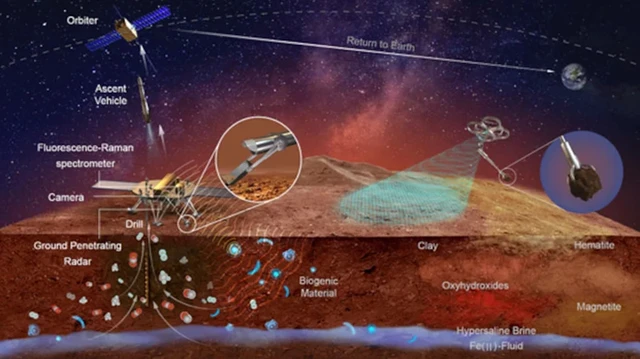
The technical architecture of the Chinese mission is predicated on a philosophy of radical simplification. According to the current roadmap, following a three-year transit, the lander will execute a soft landing, drill approximately two meters into the surface, and collect roughly 500 grams of regolith. The active surface phase is expected to last about two months, after which the sample container will be launched into orbit to be intercepted by a return vehicle. To execute this sequence, Beijing plans to deploy two Long March 5 heavy-lift rockets.
The fundamental divergence between the Chinese and American strategies lies in the logistics of sample recovery. NASA originally designed an extraordinarily complex, multi-stage system: while the Perseverance rover has already cached samples, retrieving them requires the deployment of a separate landing module to collect the containers and ferry them into orbit. In contrast, China is betting on a stationary module that integrates drilling, collection, and launch capabilities. This approach significantly reduces the number of critical points of failure, although it imposes rigid constraints on the landing site, as the module lacks mobility.
Despite the apparent simplicity, the engineering hurdles remain formidable. The most precarious phase is the ascent from the Martian surface. Escaping the planet's gravity well and achieving a precise orbital trajectory for rendezvous with the return module demands flawless calculations and absolute propulsion reliability. The project has now entered the prototyping phase—a move that underscores Beijing's resolve, though it offers no guarantee against technical setbacks.
Simultaneously, the American MSR program has descended into a deep financial crisis. Cost estimates have ballooned to staggering figures—between $7 billion and $11 billion—while Lockheed Martin previously suggested the project could be realized for $3 billion. This discrepancy has fueled political tension; the fate of the samples already cached by Perseverance now hinges on the passage of the 2026 NASA Authorization and Appropriations Act, which could potentially secure the necessary $8 billion.
In this competition, scientific objectives are inextricably linked with geopolitical ambitions. Being the first to return Martian soil would serve as a powerful symbol of technological triumph for China, cementing the success of its previous lunar missions. Nevertheless, the fundamental goal remains the search for biosignatures and evidence of ancient life. On this front, China maintains a stance of open cooperation, proposing that the international community jointly analyze the recovered materials to advance the field of planetary science.
 Tesla Roadster: A New Wave of Ambition