In an era of pervasive digital noise, the line between deep immersion and constant distraction has become perilously thin. The battle for concentration—whether within the chaos of open-plan offices or the solitude of home studios—has evolved into a universal challenge for today's professionals. Flipper Devices, a company that carved out a reputation as a purveyor of hacker tools, is now making a surprising pivot toward the productivity market. Their latest offering, the Busy Bar, aims to materialize the invisible "flow state," translating a user's mental focus into a clear, tangible visual signal for everyone in their vicinity.
Flipper Devices first made its mark with the Flipper Zero—an iconic device that became the "Swiss Army knife" for information security enthusiasts and radio protocol researchers. However, the company's new strategic pivot suggests an ambition to expand beyond the niche hacker community. The Busy Bar is not merely another gadget; it is a physical interface for attention management, translating the concept of digital hygiene into the material world.
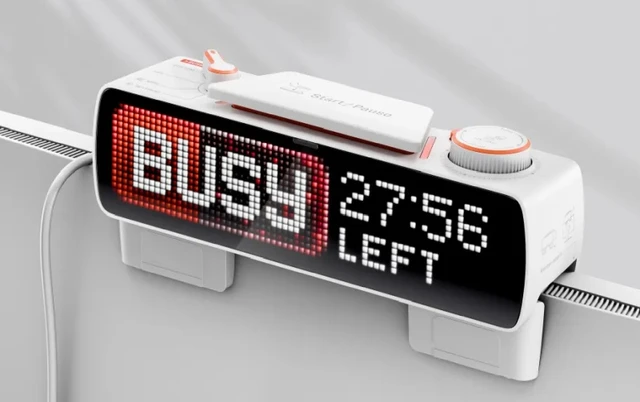
Visually, the device evokes the aesthetic of classic digital desk clocks, where functionality is emphasized through a wealth of tactile controls: knobs, buttons, and switches. The centerpiece is a full-color LED matrix display with a resolution of 72 × 16 pixels. Despite its compact size, the panel boasts a brightness of up to 400 nits and supports 16 million colors, enabling the creation of high-contrast, intuitive notifications. An integrated ambient light sensor automatically adjusts the screen's brightness, ensuring the device doesn't become a distracting light source in a darkened room.
The technical sophistication of the Busy Bar is evident in its layered interface architecture. While the primary screen serves as a communication tool for the outside world, a secondary monochrome display is tucked away on the rear panel. This screen is reserved exclusively for the owner, displaying system telemetry such as connection status, remaining battery life, and current timer metrics. Control is handled via the top panel, which houses a mode switch, a start button, and a scroll wheel for menu navigation.
Endurance is powered by a 3250 mAh battery. In active mode, the Busy Bar operates for up to eight hours, while its standby time extends up to two weeks. For those preferring a stationary setup, a 15W adapter is provided, capable of a full charge in one hour. Integration into the user's ecosystem is achieved via Wi-Fi, Bluetooth, or a classic USB port.
Conceptually, the Busy Bar functions as a tool to combat cognitive overload. It is built upon the principles of the Pomodoro Technique: the user sets "deep work" blocks, during which the device signals their unavailability to those around them. This addresses a primary friction point in small-team collaboration—the hesitation to interrupt a colleague without knowing if they are currently in a state of flow.
The software ecosystem spans iOS, Android, and macOS, with Windows support expected in the near future. Of particular interest is the app-blocking feature for mobile devices, which synchronizes with Busy Bar timers, effectively turning the gadget into an external "lock" against digital distractions. For macOS users, deep integration with the system microphone has been implemented: as soon as a video call, recording, or stream begins, the Busy Bar automatically updates its status to "On a Call" and suppresses incoming notifications.
However, for the power user, the true value of the Busy Bar lies in its openness. The device is Matter-certified, guaranteeing seamless integration into smart homes powered by Amazon, Apple, and Google. Flipper Devices has gone a step further by open-sourcing the code and providing developers with an HTTP API, the MQTT protocol, and libraries for Python and TypeScript. This transforms the Busy Bar into a flexible platform where users can build custom widgets or integrate the device into complex automation workflows via a cloud API.
The device is scheduled for market launch on July 14. The first 3,000 customers on the waitlist will receive a special price of $199, after which the cost will rise to $249. Looking ahead, the Busy Bar ecosystem will expand with accessories ranging from wall mounts to custom switches, allowing users to tailor the device to the individual style of their workspace.
 The Phenomenon of the Foldable iPhone Ultra