The pursuit of raw clock speeds has long served as the primary benchmark for the latent potential of semiconductor dies. With the advent of the Blackwell architecture, the industry is once again forced to redefine the boundaries of what is possible for graphics accelerators. A recent breakthrough by the OGS overclocking team has demonstrated that modern GPUs possess capabilities far exceeding their official specifications. For the first time in the history of the RTX series, a milestone has been reached that shatters both the psychological and technical barrier of 4 GHz.
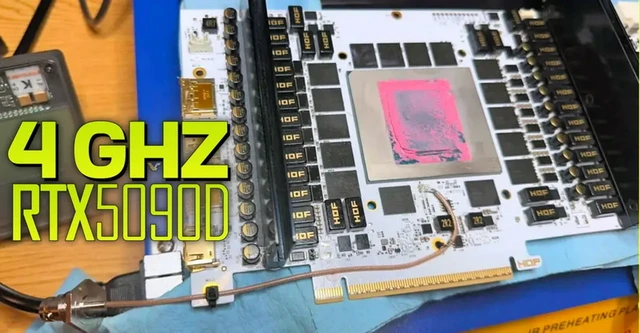
A new milestone has been etched into the HWBOT database, achieved through the extreme overclocking of a GeForce RTX 5090D, where the GPU core frequency hit a staggering 4002 MHz. This result officially cements the Blackwell architecture's status as a new frontier in clock speeds, transforming the theoretical potential of silicon into a documented reality.
The instrument of choice for this feat was the Galax GeForce RTX 5090D HOF OC Lab Edition. It is critical to note that this was the original iteration of the card, not the V2 modification with reduced video memory. This specific model was selected for its uncompromising engineering pedigree: the card features a formidable 36-phase voltage regulator module (VRM) capable of sustaining the colossal currents required during extreme voltage offsets.
Reaching such heights required a synergy of cutting-edge cooling techniques and specialized hardware. The GB202 GPU was submerged in liquid nitrogen using a Bitspower Strata LN2 GPU Pot and high-performance Thermal Grizzly Kryonaut Extreme thermal paste. However, the linchpin of the operation was the use of an Elmor External Clock Board, tuned to 28.7 MHz, which allowed the team to circumvent the inherent constraints of the onboard clock generator.
The record was validated using the GPUPI v3.3 32B benchmark, which the accelerator completed in 35 seconds and 377 milliseconds. While the core operated at 4002 MHz, the GDDR7 memory modules functioned at an effective clock speed of 1860 MHz.
A critical technical distinction is necessary here: GPUPI is a lightweight computational workload. Unlike demanding 3D renders or modern AAA titles, it does not place a maximum load on all GPU execution units. This allows overclockers to push the crystal to peak frequencies that would be unattainable in real-world production scenarios. Consequently, within the enthusiast community, GPUPI is regarded as the gold standard for documenting "peak" frequencies, even in the absence of an official global registry similar to those existing for CPUs.
The scale of the experiment is further highlighted by the rest of the testbed. The computational backbone consisted of an Intel Core i9-14900KF processor, overclocked to 6.0 GHz, paired with an Asus ROG Maximus Z790 Apex Encore motherboard. System stability was maintained by 32 GB of Corsair Vengeance DDR5 RAM and a high-capacity Corsair WS3000 power supply, ensuring unwavering power delivery during sudden transient spikes in consumption.
Ultimately, this result exists within the realm of extreme overclocking artistry. It is not a benchmark for the average user, nor does it reflect the practical performance of GPUs utilizing air or standard liquid cooling. Nevertheless, the experiment vividly demonstrates the architectural headroom of Blackwell and opens new horizons in our understanding of the limits of modern microelectronics.
 The Dawn of the 2nm Era in the New iMac