Mercury remains one of the most challenging destinations in our solar system, primarily due to the Sun's overwhelming gravitational pull. Reaching the planet demands more than raw propulsion; it requires surgical precision in orbital mechanics and hardware capable of enduring extreme conditions. After an eight-year odyssey, BepiColombo—a joint venture between ESA and JAXA—has finally entered the critical phase of its mission. The project stands as a rigorous test of contemporary engineering prowess and a testament to the power of international scientific collaboration.
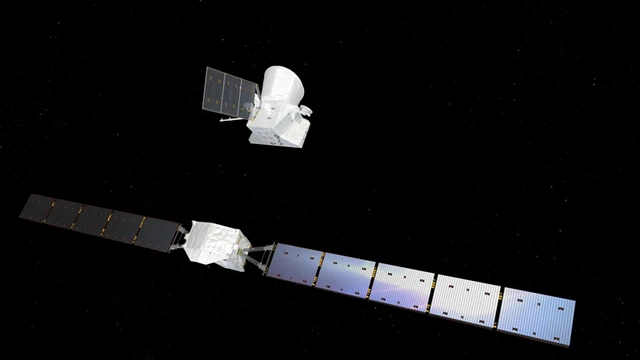
The trajectory to the solar system's innermost planet is rarely a straight line. Overcoming the relentless pull of solar gravity to achieve a stable orbit around Mercury requires a complex sequence of gravity assists and an immense amount of patience. On September 3, the BepiColombo mission reached a pivotal juncture: the Mercury Transfer Module (MTM) separated from the two scientific probes. This module had essentially served as a "cosmic tug," providing the necessary power and propulsion for the entire complex throughout its multi-year odyssey through the void.
The journey began on October 20, 2018, when an Ariane 5 rocket launched the spacecraft from the European spaceport in Kourou. Architecturally, BepiColombo is a symbiosis of two sophisticated instruments: the European Mercury Planetary Orbiter (MPO) and the Japanese Mercury Magnetospheric Orbiter (Mio). Until now, they have functioned as a single unit, relying on the MTM's resources for deep-space navigation.
However, the path to the destination has not been without its technical setbacks. In April 2024, a failure in the transfer module's power system led to a drop in the efficiency of its electric propulsion. In the unforgiving environment of deep space, such an anomaly necessitates an immediate overhaul of the entire flight strategy. Engineers were forced to recalculate the trajectory based on limited thrust, which inevitably shifted the timeline. Consequently, the arrival at Mercury was pushed back by nearly a year, to November 2026.
The process of entering the operational orbit is evolving into a complex "cosmic dance." On November 21, MPO and Mio—still linked—are expected to enter a polar orbit. This will mark the beginning of a series of 16 high-precision maneuvers designed to incrementally refine the spacecraft's orbital parameters.
The climax will occur in December: around December 9, the MPO will release the Mio probe, which will settle into its final, highly eccentric polar orbit. A week later, on December 16, the European craft will jettison the MOSIF sunshield, which protected the Japanese module from intense solar radiation. The final milestone of this phase will be reached on March 10, 2027, when the MPO finally enters its own operational polar orbit.
The complexity of this operation lies in the fact that it cannot be accomplished with a single, decisive deceleration burn. Instead, the team faces a six-month period of continuous guidance and adjustment, making this mission one of the most technically ambitious undertakings in the history of modern astronautics.
The full-scale scientific program is set to launch on April 6, 2027. The research strategy relies on the synergy of two spacecraft operating on different orbits. The MPO will handle the study of geology, surface composition, and internal structure, effectively creating a detailed map of Mercury. Simultaneously, Mio will focus on analyzing the magnetic field and the interaction between the planet's magnetosphere and the solar wind. This tandem is expected to operate in orbit for approximately two years, unlocking the secrets of the smallest and most scorched world in our system.
 A Pragmatic Approach to Lunar Equipment Design