The global race for AI supremacy has decisively shifted from the realm of algorithms to the domain of hardware. Faced with stringent technological constraints, China is doubling down on the development of a fully autonomous and scalable computing ecosystem. Alibaba's latest initiatives signal a strategic pivot from incremental optimizations toward building the foundational infrastructure required for next-generation models. The unveiling of the Zhenwu V900 accelerator serves as the cornerstone of an ambitious roadmap aimed at achieving Artificial Superintelligence (ASI).
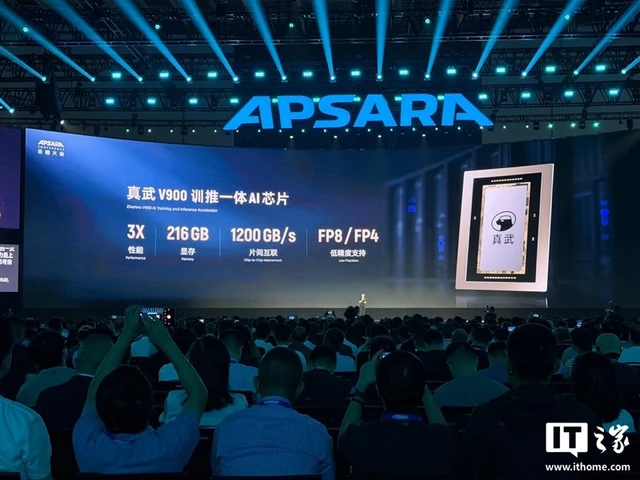
In today's hierarchy of technological hegemony, compute has become the ultimate currency. Through its T-Head Semiconductor division, Alibaba has unveiled the Zhenwu V900—a solution positioning itself as the most powerful AI accelerator in China. This chip does more than just deliver a threefold performance increase over its predecessor, the M890; it establishes a new benchmark for compute density within the region.
The V900's technical specifications are formidable, particularly regarding throughput. The device is equipped with 216 GB of HBM memory, a critical requirement for processing massive datasets in real time. Support for FP8 and FP4 precision allows for a significant reduction in memory overhead and power consumption without substantial loss of accuracy—a global trend in the optimization of Large Language Models (LLMs). Of particular note is the inter-chip interconnect, boasting speeds of 1.2 TB/s. This bandwidth enables the clustering of up to 500,000 chips into unified computational arrays, effectively transforming them into a single, monolithic supercomputer for training and inference.
However, the V900 is merely the opening gambit of a broader roadmap. T-Head is already developing the next generation of accelerators, the Zhenwu J900, slated for release in the third quarter of 2028. Parallel to this, the company is advancing its own line of central processors, the Yitian 720 and 730. The latter will be a landmark product, as it will be based on a fully proprietary microarchitecture optimized specifically for agentic AI. This marks a pivot from general-purpose computing toward specialized hardware, where the CPU and GPU operate in tight symbiosis to manage complex autonomous agents.
Alibaba's strategic trajectory now rests on three pillars: specialized silicon, cloud infrastructure, and proprietary AI models. This synergy is essential for achieving Artificial Super Intelligence (ASI)—a level of intelligence that surpasses human capability across all domains. As part of this ambition, the Qwen team is preparing the release of Qwen 5, a model of staggering scale, featuring between 5 and 10 trillion parameters.
To appreciate the magnitude of this leap, one only needs to look at current benchmarks. The flagship Qwen 3.8-Max possesses 2.4 trillion parameters, while China's largest open model, Kimi K3, reaches 2.8 trillion. Scaling this to 10 trillion will allow the model to tackle problems of unprecedented complexity and sustain prolonged cognitive processes that remain beyond the reach of current LLMs.
The final piece of this ecosystem is Qwen Intelligence, a comprehensive platform for creating AI agents. It is designed to push neural network capabilities beyond the confines of chatbots by integrating Qwen tools directly into smartphone hardware. In doing so, Alibaba is constructing a vertically integrated stack: from the transistors in the Yitian and Zhenwu chips to the intelligent agents in the end-user's pocket.
 AMD’s Trillion-Dollar Leap in the Age of AI