The era of cumbersome VR headsets is steadily yielding to more discreet and functional wearables. Recent market data reveals an explosion in the AI-powered smart glasses segment, signaling a fundamental paradigm shift in how we interact with digital environments. Paradoxically, the dominant trend has been the abandonment of visual displays in favor of a philosophy of functional minimalism. This shift exposes a fundamental tension between the industry's technological ambitions and the pragmatic realities of the end user.
The wearables market is undergoing a profound transformation. Over the last six months, shipments of AI-powered smart glasses have surged by an impressive 263%. However, beneath this quantitative leap lies a critical qualitative shift: the vast majority of devices resonating with consumers are devoid of traditional displays. A clear divide has emerged between futuristic augmented reality (AR) concepts and actual consumer preferences.
The screenless segment has become the dominant force, capturing 96% of the total market. These gadgets prioritize edge AI processing, transforming glasses into an intelligent assistant that interacts via voice and audio without cluttering the user's field of vision with interfaces. The momentum here is striking, with year-over-year shipment growth reaching 258%.
This segment is characterized by a near-monopoly. The strategic alliance between Meta Platforms and EssilorLuxottica controls 94% of the market, demonstrating a powerful synergy between a tech giant and an industry leader in optics. This strategy has allowed them to create a product that looks like a standard accessory while housing a sophisticated intelligent engine. Other players, including Xiaomi and Alibaba, remain marginalized, each holding less than 1% of the market.
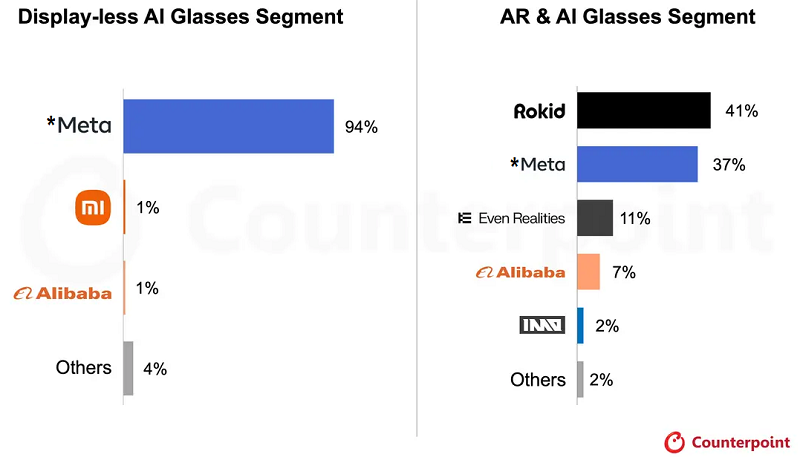
A starkly different picture emerges in the segment of glasses featuring displays and full AR capabilities. While this market technically posted the highest growth—449% year-over-year—analysts emphasize that this is primarily a "low base effect." In reality, these devices account for only 4% of the total smart glasses market. Their expansion is stymied by three classic barriers: technological immaturity, high component costs, and cumbersome form factors that make them unattractive for daily wear.
Chinese manufacturers dominate this narrow but promising niche. Companies such as Rokid, Even Realities, and Alibaba are leveraging mature local supply chains to iterate hardware solutions more rapidly and cost-effectively. China has become the largest market for AR glasses (45%), followed closely by North America at 41%. Notably, despite its dominance in screenless wearables, Meta ranks only second in the AR segment with a 37% share.
The geographic distribution of demand highlights diverging marketing strategies. While the screenless market is heavily concentrated in North America (50%) and Western Europe (28)—aligning closely with Meta's promotional strategy—AR devices are more evenly split between China and the US. Other regions, including India, Latin America, and the UAE, currently play a secondary role.
Despite the optimistic growth, the industry faces significant headwinds. Economic pressures are mounting as component costs rise, particularly for memory chips, which could slow the pace of price reductions. However, a more profound challenge is the societal demand for privacy. Integrated cameras have sparked predictable public backlash, forcing manufacturers to seek compromises—ranging from functional limitations on recording capabilities to the complete removal of cameras in favor of microphone arrays.
The future of the category lies in the evolution of voice interfaces and the integration of more sophisticated AI agents capable of deep contextual awareness. Technological breakthroughs in energy efficiency and sensing will make these devices even more unobtrusive. Competition is expected to intensify sharply once full product lines from Google, Samsung, and Apple hit the market, finally transitioning smart glasses from a niche gadget into a ubiquitous tool for interacting with the world.
 AMD’s Trillion-Dollar Leap in the Age of AI