The return of humans to the lunar surface under the Artemis program stands as one of the most ambitious and formidable undertakings in modern space exploration. Yet, the friction between theoretical specifications and engineering realities frequently manifests as critical delays in launch timelines. This tension has come to a head in the development of next-generation spacesuits, where a pursuit of absolute perfection nearly jeopardized the Artemis IV mission schedule. To guarantee a crewed landing by 2028, NASA is pivoting away from the vision of an all-encompassing "super-complex" in favor of a strategy rooted in iterative simplification.
The Artemis IV mission is poised to be a defining milestone of the 21st century, returning humans to the lunar surface—specifically to one of the most hostile environments imaginable: the lunar South Pole. In a realm of extreme thermal gradients and a total vacuum, a spacesuit transcends its role as mere apparel, evolving into a fully autonomous, person-scale spacecraft. This inherent complexity became the project's primary bottleneck; the initial technical requirements were so stringent that the resulting prototype became too heavy and cumbersome for effective operational use.
The original design specifications envisioned a system capable of supporting six full extravehicular activities (EVAs) over a six-and-a-half-day lunar stay. Furthermore, the equipment had to remain fully operational after 210 days of standby storage and withstand up to two hours on the Moon's dark side, where temperatures plummet to critical lows. The attempt to consolidate all these functions into a single unit resulted in an over-engineered architecture that stifled development velocity and severely restricted astronaut mobility.
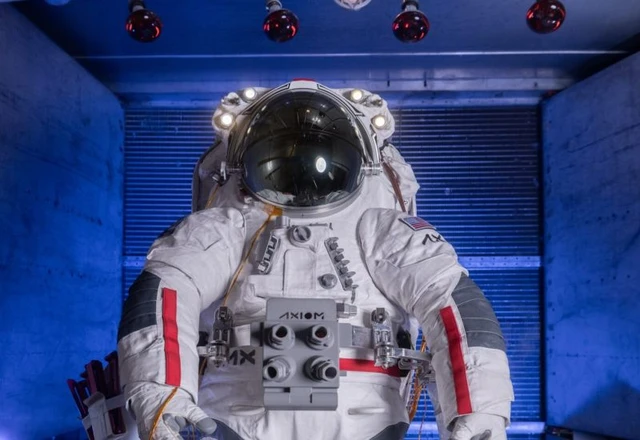
The development process was fraught with significant organizational hurdles. Initially, Axiom Space and Collins Aerospace collaborated on the project, but the latter was eventually removed due to financial instability and chronic schedule slippage. Consequently, Axiom Space became the sole contractor tasked with the mission, though they too struggled to realize the original vision. The situation reached a critical juncture where NASA and Axiom Space shifted to a regime of near-constant collaboration, convening six days a week to pivot the project's trajectory in real-time.
The solution arrived in the form of a strategic pivot: abandoning the pursuit of a "universal" suit in favor of a streamlined version dubbed the Sortie Suit. This iteration prioritizes fundamental imperatives—mass reduction, structural simplification, and enhanced ergonomics. The primary focus has shifted toward human mobility and seamless integration with lunar module systems, both of which are critical for safety and operational efficiency on the surface.
This approach mirrors the contemporary philosophy of high-tech systems engineering: prioritizing iterative refinement over the creation of a monolithic, feature-bloated product. NASA intends to deploy the Sortie Suit as the baseline tool for initial landings, subsequently leveraging real-world telemetry and practical lunar data to gradually reintroduce more rigorous requirements for autonomy and protection. In this context, a calculated technological compromise today is the only viable path to ensuring mission success tomorrow.
 The Imprint of the Universe's Elusive Matter