The pursuit of raw performance in the realm of GPUs has always been a clash between engineering ingenuity and the limits of extreme cooling. While the arrival of the Blackwell generation promised a quantum leap in efficiency, the true boundaries of the silicon are only ever revealed in the hands of professional overclockers. A recent breakthrough by Team OGS has propelled the GeForce RTX 5090D past a critical psychological and technical threshold. This achievement does more than just set a new world record; it exposes the latent potential embedded within Nvidia's latest architecture.
Breaking the 4 GHz barrier has long been the "holy grail" for consumer-grade graphics processors. However, the OGS team has turned this ambition into reality, pushing a GeForce RTX 5090D to a staggering 4002 MHz. This triumph was made possible through the convergence of top-tier hardware and a profound understanding of clock generator mechanics.
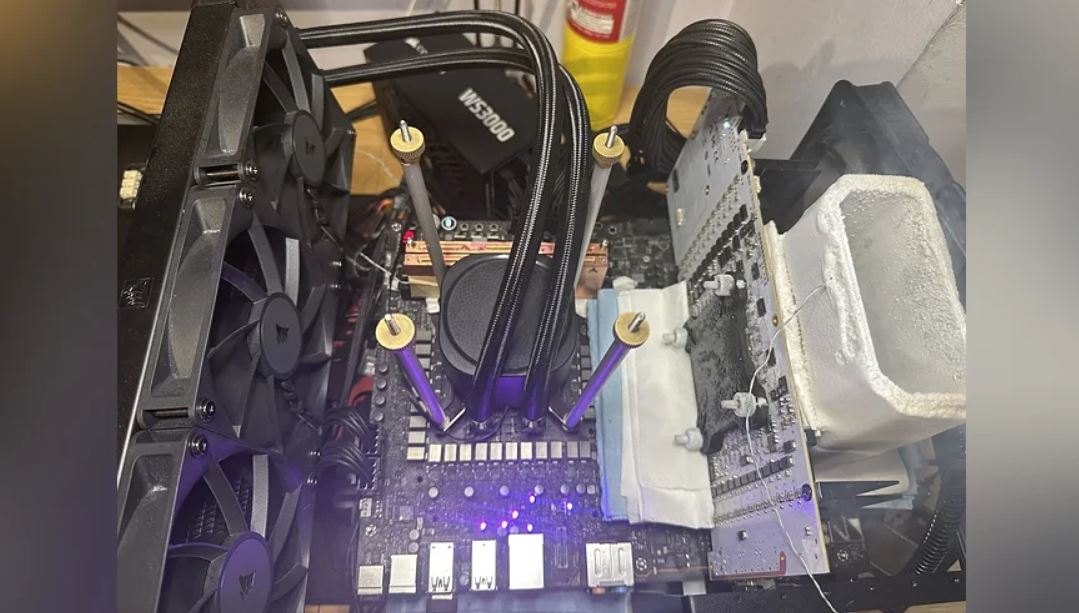
The bedrock of this achievement was the GALAX HOF OC Lab, a tool engineered specifically for extreme overclocking. Its power delivery system is a masterclass in engineering overkill: 36 power phases and dual 16-pin connectors ensure a rock-solid current supply, even under the colossal loads inevitable when pushing a chip to its absolute limit.
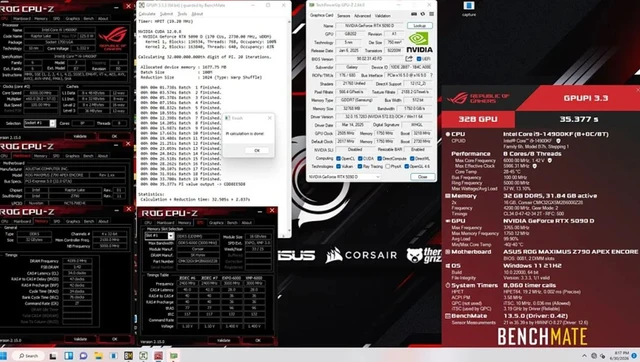
The pivotal technical maneuver involved modifying the base clock. The standard 27 MHz generator was replaced with a specialized Elmor ECB board, allowing the reference clock to be raised to 28.7 MHz—effectively boosting all GPU frequencies by 6.3%. Alongside the core, the GDDR7 video memory was also pushed to the limit, reaching 1860 MHz, which translates to an effective speed of nearly 30 Gbps. The transition to GDDR7 represents one of the most significant technological leaps of this series, providing unprecedented memory bandwidth.
The real-world performance of this overclock was validated via the GPUPI v3.3 32B benchmark. The system clocked in at 35.377 seconds, not only shattering the world record but slashing the previous best time by more than a full second. To ensure platform stability, the team utilized top-tier components: an Asus ROG Maximus Z790 Apex Encore motherboard and an Intel Core i9-14900KF processor, both of which minimized data exchange latency between the CPU and GPU.
A critical nuance was the use of the first-generation RTX 5090D. Unlike the subsequent V2 variant, which featured reduced core and memory specifications, the original model retained the full potential of the GPU, making it identical to the standard RTX 5090. This made it the ideal candidate for chasing world records on the HWBOT platform.
Thermal management was handled via liquid nitrogen. The use of a Bitspower Strata LN2 GPU Pot, paired with Kryonaut Extreme thermal paste, kept the die at deep sub-zero temperatures, preventing thermal throttling even under extreme voltage.
Despite Nvidia's hegemony in the ultra-high-end segment, the overclocking scene remains fiercely competitive. AMD previously demonstrated impressive results with the Radeon RX 9060 XT, which reached 4769 MHz under the guidance of Bill "Sampson" Alverson and Allen "Splave" Golibersuch. Nevertheless, the OGS record on the Blackwell architecture underscores that Nvidia's new cards possess the architectural headroom to compete for the title of the fastest silicon in history.
 The Speed Limits of Modern Gaming Displays