The consumer CPU market is undergoing a fundamental transformation, shifting the balance of power across the industry. For years, Intel’s hegemony appeared absolute; yet today, we are witnessing a rapid surge in AMD’s influence. Crossing the critical 30% market share threshold marks the symbolic end of an era of undisputed monopoly. Simultaneously, the expansion of ARM-based architectures is calling into question the very viability of the traditional x86 paradigm.
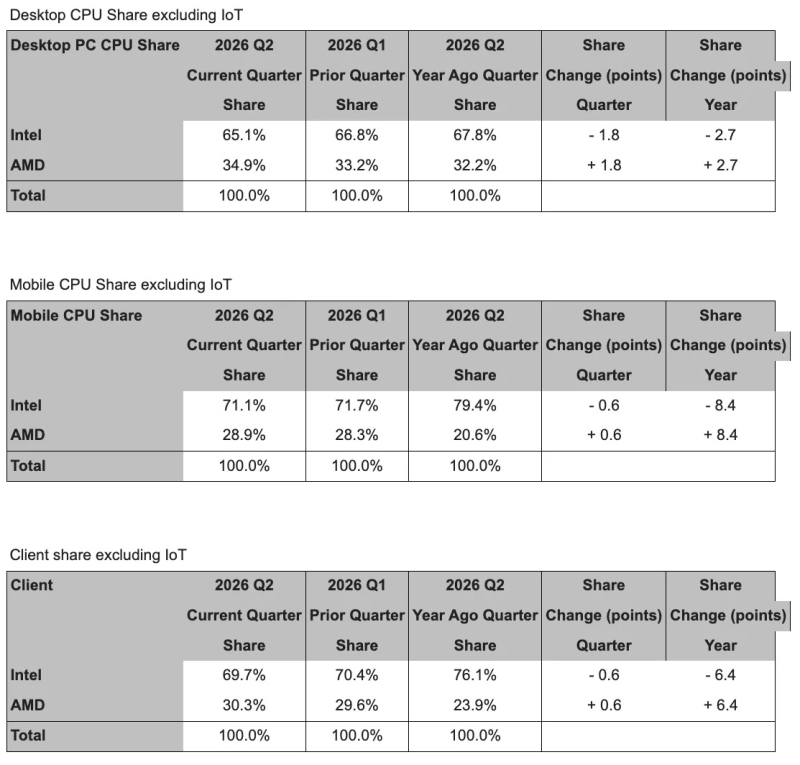
The computing industry has reached a pivotal milestone. According to the latest Q2 2026 data from Mercury Research, AMD has, for the first time, breached the psychological threshold of a 30% market share in x86 client processors. The company currently stands at 30.3%, while Intel holds 69.7%. The trajectory of this growth is striking: just two years ago, AMD's position was limited to 21.1%. This surge is not merely a fleeting success but indicative of a systemic shift in the preferences of both OEMs and end-users.
A granular analysis of market segments reveals that AMD's success, while uneven, is resolute. In the desktop sector, the company demonstrates its strongest footing, capturing 34.9% of the market. However, the most significant progress is evident in the mobile segment, where AMD's share has reached 28.9%. Historically, the laptop market was the most impenetrable fortress, where Intel maintained deep-rooted ties with OEMs; AMD's expansion into this sector speaks volumes about the quality and power efficiency of its latest processor lineups.
Yet, the struggle within the x86 ecosystem is only part of a broader evolution. A new threat has crystallized on the horizon: ARM. Apple, Qualcomm, and MediaTek are aggressively integrating their solutions into the laptop segment, offering a viable alternative to traditional computing. The share of ARM-based processors in overall client PC shipments has climbed to 15.3%, marking a new historical peak. The migration toward ARM is driven by a global imperative for energy efficiency and the integration of all system components onto a single chip (SoC), enabling devices with unprecedented battery life.
Despite the internal battle for market share, the overall state of the x86 desktop processor segment is cause for serious alarm. Shipment volumes in this sector have plummeted by more than 20% compared to the same period last year. Experts describe the current market condition as profoundly unsatisfactory, and the root of this decline lies beyond the scope of brand rivalry.
The primary catalyst for this instability has been an acute memory shortage. The scarcity of components has triggered cascading price hikes, affecting not only RAM and SSDs but also high-performance graphics cards, which are critically dependent on VRAM capacity. Consequently, the cost of fully-fledged workstations and gaming rigs has surged, naturally suppressing end-user demand. The market now finds itself in a paradox where technological progress and the fierce competition between AMD and Intel are colliding with the rigid constraints of semiconductor supply chains.
Ultimately, we are witnessing the emergence of a multipolar landscape. On one side, AMD is successfully closing the gap with Intel by offering highly competitive solutions. On the other, ARM is transcending its origins as a purely mobile architecture to become a formidable player in the personal computing market. The industry's future now hinges not only on clock speeds and core counts but on the ability of manufacturers to overcome infrastructural crises and deliver a new paradigm of energy-efficient computing.
 The Price of Acceleration: CXMT’s Rapid Push into Memory