Space is often envisioned as a static void, yet for observational instruments stationed on other worlds, it reveals itself as a precision-engineered dynamic mechanism. From its post in Jezero Crater, the Perseverance rover captured a rare alignment of celestial mechanics—the occultation of Earth by one of the Red Planet's moons. This event transcends mere technical achievement; it is a visual validation of the profound complexity inherent in interplanetary interactions. Through exacting calculations, a fleeting glimpse into the cosmos was elevated into a rigorous scientific observation.
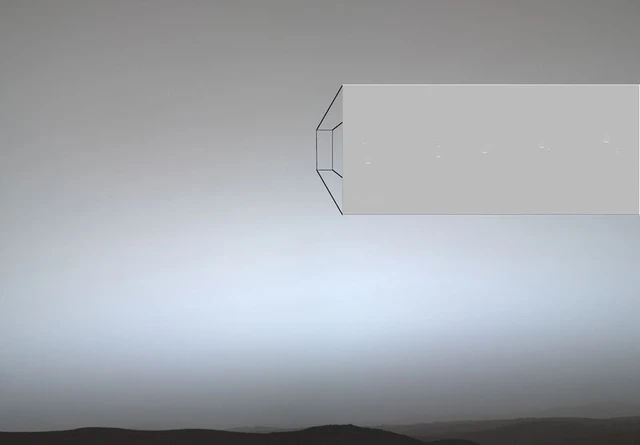
On the evening of July 2, 2026—marking Sol 1907 of its mission—Perseverance captured a moment that underscores humanity's profound isolation within the vastness of the Solar System. Using its Mastcam-Z imaging system, the rover documented Earth as a tiny, luminous speck momentarily vanishing behind the unlit limb of Phobos, Mars' largest moon.
The capture demanded surgical precision and rigorous mathematical modeling. The resulting composite image reveals a complex orbital choreography: Earth drifts slowly from the upper-left to the lower-right of the frame, while Phobos traverses the field of view in the opposite direction. This sequence was captured across nine separate frames, five of which were critical in documenting the phases of approach, total occultation, and the eventual reappearance of the Blue Planet.
From a technical standpoint, the scale of the event is strikingly ephemeral. At the moment of observation, the distance between the rover and Earth was approximately 314 million kilometers, reducing our home planet to a single pixel on the camera's sensor. In contrast, Phobos—despite its modest dimensions (roughly 27 km across) and irregular, potato-like morphology—appeared imposing. Due to its low orbit, just 7,800 km above the Martian surface, it appeared to an observer in Jezero Crater to be roughly one-third the size of the Moon as seen from Earth.
In astronomical terms, this phenomenon is classified as an occultation. It is crucial to distinguish this from a standard eclipse: in this instance, Earth did not enter Phobos' shadow; rather, it was physically obstructed by the moon. Similarly, this was not a transit, as the obstructing body was visually larger than the object being observed.
The difficulty of capturing such a moment lies in the satellite's orbital dynamics. Phobos traverses the Martian sky three times per day; catching the precise alignment with a distant Earth required a perfect synchronization of the orbital positions of all three celestial bodies. This event demonstrates the depth to which we have integrated automated observation systems into deep-space exploration, effectively transforming remote probes into fully functional observatories.
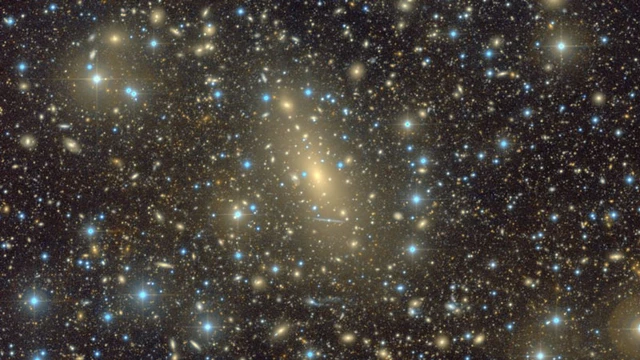 The Phenomenon of the Supermassive Galaxy IC 1101