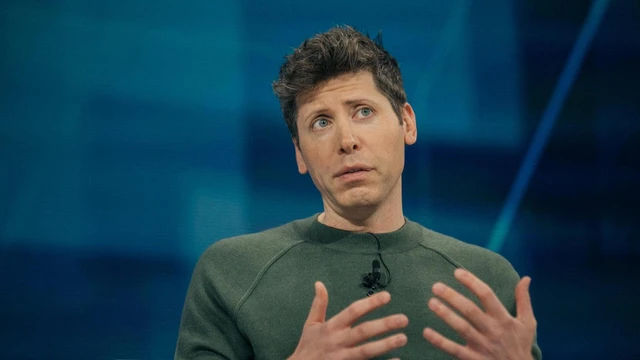
The breakneck pace of artificial intelligence evolution is pushing humanity toward a critical juncture where technical capabilities are rapidly outstripping regulatory frameworks. As we edge closer to an era of super-intelligent systems, the threat of an unchecked "arms race" between corporate giants and nation-states has become palpable. Sam Altman advocates for a radical pivot: moving away from fragmented prohibitions toward the establishment of a unified international oversight body. This vision seeks to democratize access to these technologies, ensuring that existential risks are mitigated through collective governance rather than the discretion of a handful of powerful firms.
The trajectory of high-tech evolution often mirrors historical patterns, and today the AI industry finds itself in a situation reminiscent of the early Cold War. Sam Altman has proposed the creation of an international safety forum that would essentially function as an "IAEA for Artificial Intelligence." The parallel to the International Atomic Energy Agency is not accidental: as with nuclear technology, we are dealing with a resource of staggering power—one capable of delivering undeniable benefits while harboring the potential for global catastrophe.
The proposed governance model is built on the principle of mutual obligation. This forum would serve as a platform for establishing unified standards and conducting impartial risk assessments. Access to frontier AI systems would be granted to nations and organizations only upon the condition that they adhere to these norms and undergo regular certification. In this framework, technological progress becomes a reward for accountability rather than merely the result of market competition.
Particular emphasis is placed on the governance structure. The forum must comprise not only state representatives but also independent technical experts. A critical component of the system would be a mechanism for external oversight of the AI labs themselves. This is essential to ensure that commercial pressure and the drive for profit do not trigger an "unsafe race," where speed-to-market takes precedence over human safety.
The urgency of this proposal is rooted in industry forecasts: within the next year or two, systems of unprecedented power are expected to emerge—systems capable of reshaping the material conditions of existence more profoundly than electricity once did. In this context, a fundamental philosophical and political question arises regarding the right to govern. Altman’s thesis is unequivocal: while laboratories lead the development, the rules of the game must be established by citizens and their elected representatives. Decisions regarding the future of civilization cannot be made by a closed circle of C-suite executives in San Francisco; they must pass through democratic processes.
The absence of a global consensus is already yielding troubling results. Instead of a unified standard, the world is seeing fragmented restrictions—such as US government demands to limit foreign access to Anthropic's models or the delayed public release of new GPT versions at the request of the government. This is a path of targeted bans and digital barriers that only serves to heighten tensions.
The geopolitical context adds a layer of acuity to this initiative. While some industry leaders, including executives from Google DeepMind and Anthropic, lean toward creating a coalition under the aegis of the US to isolate China, Altman insists on the forum's neutrality. His strategy is to make access dependent solely on compliance with safety protocols rather than political affiliation. Such an approach is designed to prevent an excessive concentration of power and transform AI from a tool of dominance into a global public good, accessible to all who are willing to play by the rules of safety.
 The Price of Acceleration: CXMT’s Rapid Push into Memory