Modern graphics accelerators are marvels of engineering—complex systems where thermal management directly dictates both operational stability and hardware longevity. For too long, users have relied on aggregated temperature metrics, broad averages that often mask the critical state of individual components. Recent research has revealed that Nvidia's hardware provides far more granular data than standard software interfaces typically expose. This discovery unlocks new potential for precision diagnostics and the deep optimization of cooling architectures.
In the realm of high-performance computing, it is widely accepted that memory temperature readings displayed in popular utilities like GPU-Z or HWInfo provide a comprehensive overview of the subsystem's health. However, practice has revealed that this figure is essentially an "averaging illusion." In reality, while the driver receives data from every individual memory chip, it surfaces only a single metric to the end user: the peak value among all sensors. Consequently, if one module overheats, the others may remain cool, yet the user sees only the critical spike.
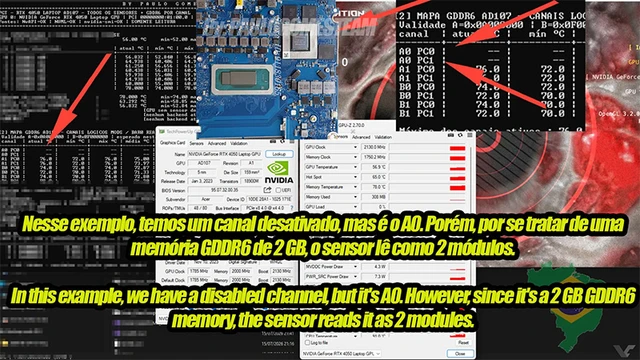
A pivotal shift in understanding this process came via a group of independent researchers who managed to bypass standard interface restrictions. Access to detailed readings was achieved through Memory-Mapped I/O (MMIO)—a mechanism where hardware resources are mapped directly into the processor's memory address space. This allowed them to read data from each memory channel individually and correlate those readings with the physical layout of the chips surrounding the GPU core.
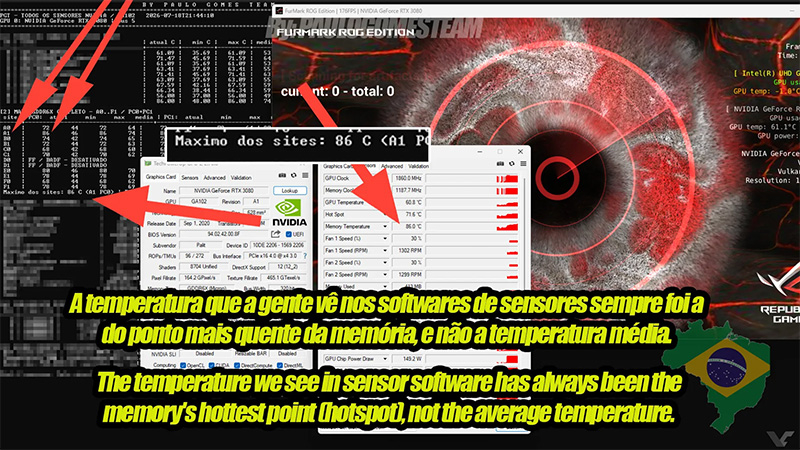
The practical utility of this approach became evident during testing of the GeForce RTX 3080 equipped with GDDR6X memory. The trials revealed substantial thermal variance between modules: while most chips operated within nominal parameters, one surged to 86°C. It was this localized hotspot that dictated the overall monitoring figure, masking the fact that the issue was isolated. Notably, GDDR6X is particularly susceptible to such fluctuations due to PAM4 signal modulation, which increases both power density and heat generation.
From a maintenance standpoint, this level of granularity transforms monitoring from passive observation into a sophisticated diagnostic tool. It now becomes possible to pinpoint a faulty thermal pad or identify a specific chip with poor heatsink contact. In scenarios where a graphics card exhibits instability, the ability to monitor each chip's temperature allows for the rapid localization of the problematic component, eliminating guesswork and the tedious process of elimination.
At present, this methodology is compatible with Nvidia's mobile GDDR6 solutions, as well as desktop RTX 30 and 40 series cards utilizing GDDR6X. Support for desktop cards featuring standard GDDR6 remains unavailable. Although dedicated software for these purposes has not yet been released to the public, the mere existence of such data confirms that Nvidia's hardware possesses far more robust diagnostic potential than commonly assumed. It is likely that this functionality will eventually be integrated into mainstream monitoring tools, fundamentally altering the approach to overclocking and the maintenance of graphics systems.
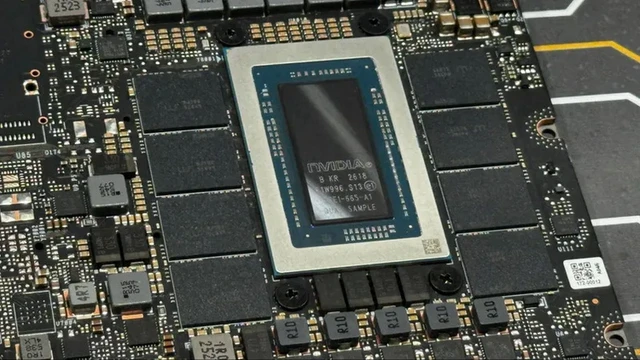 Nvidia N1X and the New Era of Arm PCs