The enterprise software landscape is currently undergoing a critical phase of AI feature consolidation. Microsoft is making a bold move to streamline the user experience, pivoting away from fragmented, standalone agents in favor of deep, seamless integration. The decision to sunset the Surveys Agent signals a strategic shift: moving away from the notion of "external assistants" and toward a paradigm of embedded intelligence. This strategy is designed to eliminate cognitive friction for the user, establishing a unified entry point for data interaction.
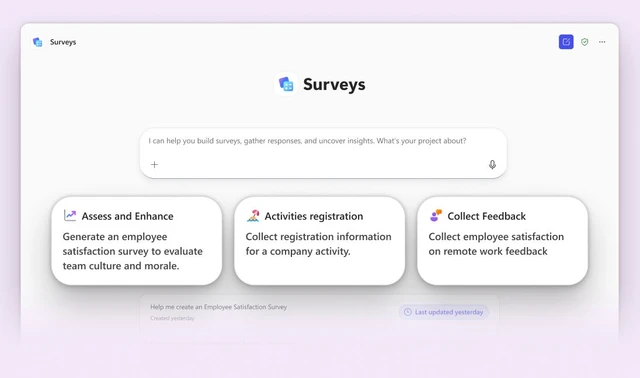
The evolution of artificial intelligence within the Microsoft ecosystem is currently undergoing a fundamental reimagining of user interfaces. As recently as August 2025, the company introduced the Surveys Agent—a specialized tool powered by Microsoft 365 Copilot designed to serve as a comprehensive orchestrator for survey management. This agent was intended to handle the entire lifecycle: from generating questionnaire structures via natural language prompts to distributing notifications to participants and exporting final datasets to Excel for deep-dive analysis.
In practice, however, the bifurcation of functionality between a standalone agent and the core application proved redundant. Microsoft concluded that users find it far more intuitive to interact with AI directly within the environment where content is actually created. Consequently, the majority of the Surveys Agent's capabilities have been migrated directly into Microsoft Forms. The cornerstone of this transition is the Dynamic Action Button (DAB)—a floating interface that allows users to trigger intelligent functions contextually within their current task without ever leaving the form workspace.
From both a technical and strategic standpoint, this consolidation is a logical progression. Maintaining multiple brands and entry points for a single objective—creating surveys—resulted in a fragmented user experience. The user journey is now linear: when a form is required, the user opens Microsoft Forms, where Copilot exists as an embedded tool rather than a third-party intermediary.
The decommissioning of the Surveys Agent will be a phased rollout, with the tool officially exiting the app store on August 31, 2026. To ensure continuity, Microsoft has implemented data preservation mechanisms: interaction histories with the agent will remain accessible via the Microsoft 365 Copilot interface, and all previously created forms will remain fully operational. Any attempts to access the legacy agent will automatically redirect the user to the unified Forms interface.
For the enterprise sector, this transition will be virtually seamless. Copilot functionality within Forms is enabled by default, eliminating the need for system administrators to perform manual configurations or deploy additional access policies.
This move is part of a broader strategic effort to streamline the Microsoft ecosystem. The company has already conducted a similar audit of SharePoint, sunsetting a number of legacy services and features. This signals a clear shift in the vendor's philosophy: a move away from feature bloat in favor of a lean, integrated, and intuitive user interface where AI is not a standalone product, but an invisible yet potent layer of automation.
 The Expansion of Semiconductor Foundry Giants