The global memory market is currently weathering a period of profound turbulence, catalyzed by the meteoric rise of AI infrastructure. An insatiable appetite for server-grade solutions has precipitated component shortages and triggered a sharp spike in consumer drive pricing, effectively placing mainstream development on hiatus. In this volatile climate, achieving an optimal equilibrium between cost and performance has become the paramount objective for manufacturers. The WD Blue SN5100 enters the fray as a strategic countermeasure, aiming to pivot the industry's perception of QLC NAND.
The modern SSD market has become a casualty of the AI boom. The construction of massive data centers is consuming colossal volumes of high-performance NAND flash, leading to an inevitable shortage in the consumer sector. Haunted by previous cycles of overproduction, manufacturers are expanding capacity cautiously, preferring to pivot their resources toward the more lucrative enterprise segment. Consequently, the retail SSD market has ceased to be a driver of innovation; new hardware platforms are rare, and most "new" releases are merely iterative variations of legacy solutions.
Against this backdrop, the release of the WD Blue SN5100 feels less like another product launch and more like an attempt to provide the market with a viable, affordable alternative in an era of escalating costs. The drive is essentially a streamlined iteration of the flagship Black SN7100, where the primary cost-efficiency strategy was replacing TLC memory with QLC.
The internal architecture of the SN5100 demonstrates an impressive level of integration. In the 2TB version, the entire hardware footprint is concentrated into just two chips: the controller and a single memory die. This was made possible by the adoption of BiCS8 QLC—a cutting-edge 218-layer NAND with record-breaking bit density (2 Tbit per die). Such a layout not only simplifies the physical design but directly reduces power consumption and manufacturing costs.
At the heart of the device is the 6nm SanDisk Polaris 3 controller. This third-generation, four-channel DRAMless solution has already proven its mettle in the Black series. In essence, the SN5100 is an architectural sibling to its more expensive counterpart, sharing the same PCB while employing a different data storage structure.
For many users, the primary point of contention remains the reputation of QLC memory. Historically, such drives were viewed as slow and lacking in endurance. However, modern BiCS8 QLC, paired with advanced error-correction algorithms, is shifting the paradigm. SanDisk has implemented nCache 4.0 dynamic SLC caching, which efficiently leverages free space to accelerate write operations.
Practical benchmarks reveal that in typical user scenarios, the gap between TLC and QLC has nearly vanished. In single-threaded write operations, the SN5100 delivers speeds that often surpass many DRAMless TLC solutions. While speeds eventually drop to 420 MB/s once the SLC cache is exhausted, this throughput remains more than sufficient for the vast majority of home-use tasks. The only notable drawback is the "garbage collection" process during the deletion of large data arrays, which can cause brief system micro-stutters—though these are negligible for the average user.
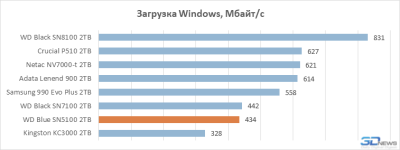
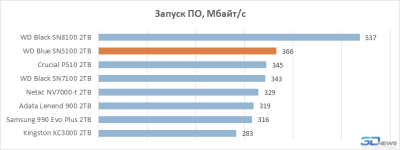
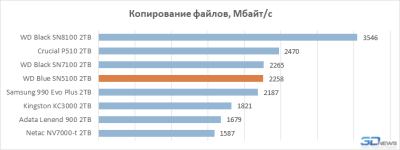
In composite file workloads—such as copying and archiving within a single drive—the WD Blue SN5100 performs unexpectedly well. The nCache 4.0 optimizations allow it to outperform even more expensive models, including some PCIe 5.0 solutions. In everyday productivity tasks (PCMark 10), the drive performs on par with the best DRAMless devices on the market, making it an ideal choice for office work and general home use.
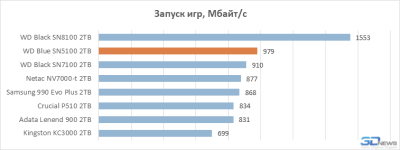
Gaming performance deserves particular mention. In 3DMark Storage tests, the SN5100 delivers remarkable results, effectively placing it in the same league as high-speed PCIe 5.0 SSDs. This proves that sophisticated firmware optimization can compensate for the physical limitations of the memory type, transforming a budget drive into a fully capable gaming tool.
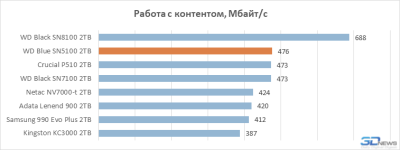
However, the professional segment remains a vulnerability. Under heavy workloads (SPECworkstation 4), the architectural constraints of QLC begin to surface; here, the SN5100 lags noticeably behind TLC models, making it unsuitable for demanding engineering or scientific applications.
The thermal profile of the device is impressive. Thanks to the energy efficiency of BiCS8 and the optimization of the Polaris 3 controller, the drive generates very little heat. Even without a heatsink, it does not reach throttling temperatures under intensive loads, allowing for confident installation in compact laptops or systems with limited airflow.
In summary, we can conclude that the era of "QLC phobia" is over. The WD Blue SN5100 proves that with a disciplined engineering approach—combining mature memory, a powerful controller, and refined software—the cost savings become tangible while the performance loss remains imperceptible to the mass market. It is a balanced solution that restores the accessibility of high-speed storage in an era of component scarcity.
 The Era of Layoffs in the Global Tech Industry