The contemporary desktop CPU market is undergoing a peculiar transformation, as manufacturer priorities pivot sharply toward AI-driven server solutions. Against this backdrop, the cost of migrating to next-gen platforms supporting DDR5 has become prohibitively expensive for many, breathing new life into legacy standards. AMD sought to capitalize on this trend by launching an anniversary edition of its former flagship for the Socket AM4 platform. Yet, beneath the celebratory veneer lies a contentious product that calls into question the actual rationality of the investment.
The semiconductor industry has reached a critical inflection point. The explosion of data centers and neural networks has forced giants like AMD and Intel to pivot their production capacities, effectively pushing the consumer segment to the periphery. Consequently, the arms race in desktop CPUs has decelerated, and pricing for existing models has become volatile. In this climate, the aging Socket AM4 platform has unexpectedly found a second wind: the price gap between DDR4 and DDR5 has widened to such an extent that upgrading a system has become a complex financial conundrum for many users.
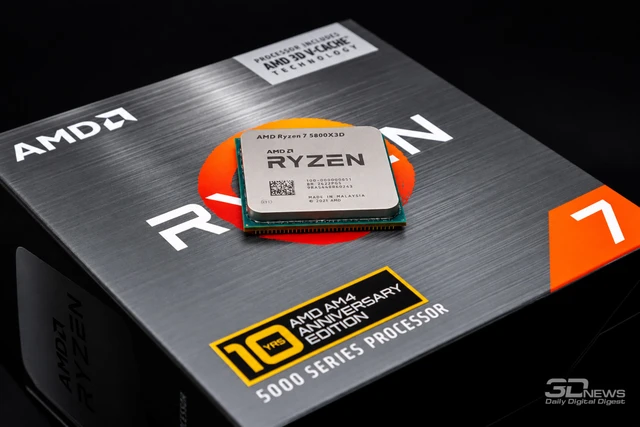
It is against this backdrop that AMD decided to reintroduce the Ryzen 7 5800X3D, which had been discontinued two years ago. This new iteration arrives as the "10th Anniversary Edition." While formally presented as a tribute to the platform's decade of existence, it is, in reality, a pragmatic attempt to offer legacy system owners a straightforward path to boosting gaming performance without the need to replace the motherboard or RAM.
Visually, the anniversary edition is nearly identical to the original. The packaging remains unchanged, save for a celebratory sticker. There are no collectible souvenirs or bundled coolers inside; the only tangible innovation is the Carbice Ice Pad. This thermal interface, based on vertically aligned carbon nanotubes, promises longevity and stable thermal conductivity—critical factors for systems intended to run for years without maintenance.
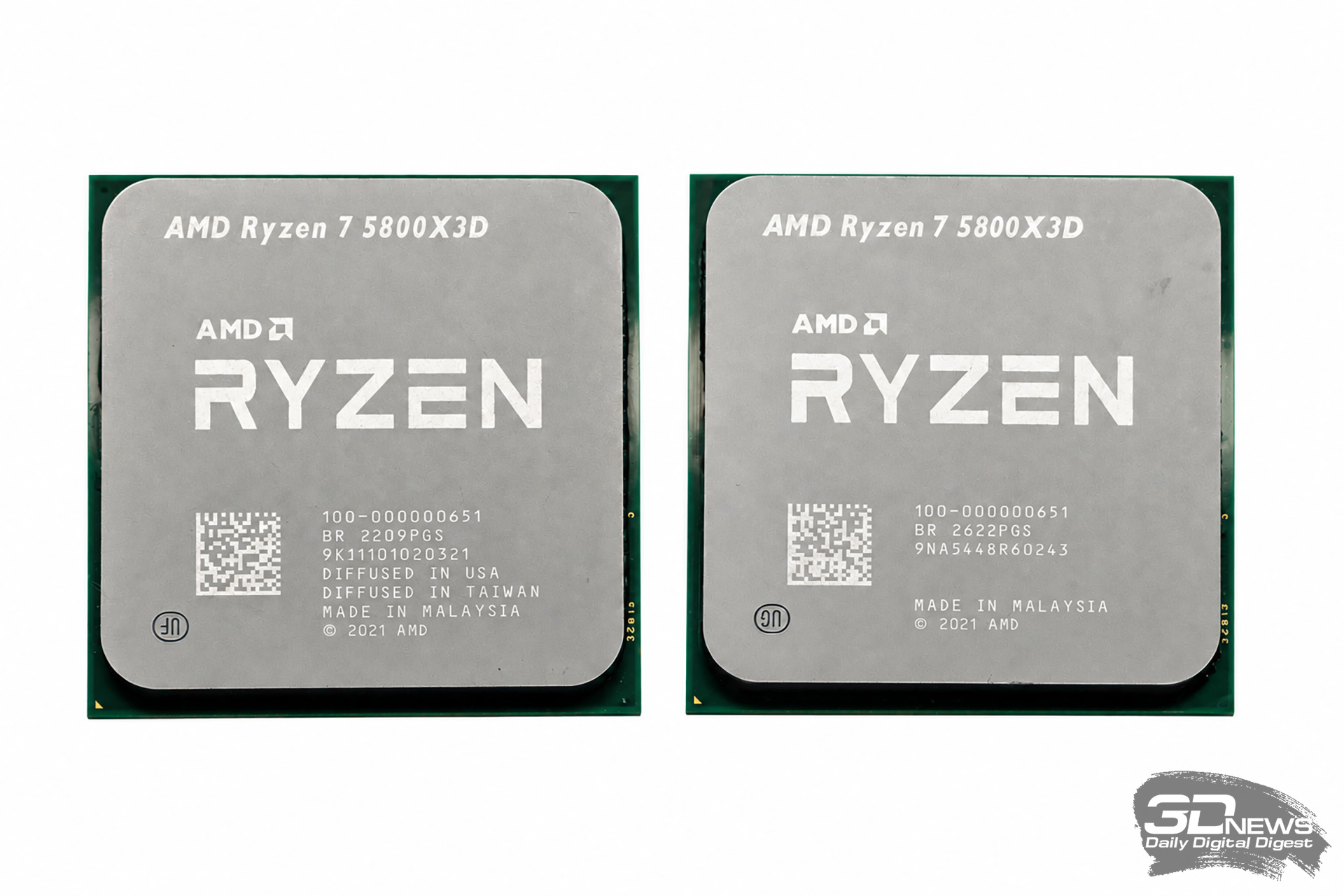
However, a closer look at the silicon reveals that the "celebration" is little more than a marketing smokescreen. Although the nominal specifications remain unchanged—8 cores, clock speeds up to 4.5 GHz, and a massive 96MB L3 cache—the assembly process has evolved. TSMC updated its 3D cache stacking methods, forcing AMD to re-qualify the product. The result of this update is unexpectedly negative: the anniversary processor runs noticeably hotter and is more power-hungry than its 2022 predecessor.
Benchmarks in Cinebench R23 reveal a concerning trend. Under multi-threaded loads, the new Ryzen 7 5800X3D hits its 90-degree thermal limit even when paired with a high-end liquid cooling system. Power consumption has climbed to 135W, up from 109W in the previous version. The likely culprit is a shift in silicon binning: the newer dies exhibit higher leakage currents, forcing the system to apply higher voltages to maintain stability.
The only effective tool to combat this overheating is the Curve Optimizer. By applying a negative voltage offset, users can curb the processor's appetite and bring temperatures back to acceptable levels; however, this requires manual tuning and offers no guarantee of consistent results across different units.
The disappointment continued with the evaluation of the innovative Carbice Ice Pad. Despite the material's impressive theoretical specifications, it lost out in practice to classic thermal pastes like Arctic MX-7. In real-world scenarios, the pad led to higher temperatures and even slight clock speed reductions due to thermal throttling. Thus, the technological novelty failed to translate into practical utility.
When it comes to performance, the Ryzen 7 5800X3D demonstrates the classic divide between synthetic benchmarks and real-world gaming. In productivity tasks—rendering, code compilation, or AI workloads—it is hopelessly outclassed by modern solutions. Even entry-level options based on Zen 4 or Intel Arrow Lake outperform it by significant margins. Yet, in gaming, the magic of 3D V-Cache still holds. For an AM4 owner, upgrading from a standard six-core CPU to this processor yields a tangible increase in smoothness and average FPS.
However, from the perspective of a new build, the value proposition becomes critical. Modern alternatives, such as the Ryzen 7 7700X or Core Ultra 5 235, offer comparable or superior gaming performance while providing access to the current AM5 or LGA 1851 platforms. Even an extreme scenario—pairing a flagship Ryzen 7 9800X3D with a single 16GB memory module—proves more advantageous: the user gains a massive leap in speed that more than compensates for the temporary limitations of single-channel memory.
At 4K resolution, the gap between processors narrows as the GPU becomes the primary bottleneck. Even here, however, the anniversary Ryzen finds no unique advantage. It remains an effective tool for "resuscitating" an old PC, but it feels like an anachronism in any modern configuration.
Ultimately, the return of the Ryzen 7 5800X3D feels more like a marketing gesture than a commitment to the user. AMD has released a product with degraded silicon quality while maintaining a premium price. It serves as a testament to the longevity of Socket AM4, but it only makes sense for a narrow group of users determined to extend the life of their legacy systems. For everyone else, this processor is expensive nostalgia that fails to meet modern standards across all key metrics.
 The Price Trajectory of Personal Computing: Future Outlook