The contemporary GPU market is undergoing a peculiar metamorphosis, where legacy hardware is finding renewed utility through radical modification. Driven by component shortages and the aggressive pricing strategies of latest-generation lineups, users are increasingly turning to deep hardware tuning of previous iterations as a viable alternative. In China, a burgeoning trend toward expanding the hardware capabilities of GPUs is gaining momentum, transforming them into cost-effective tools for AI workloads and demanding AAA gaming. At the heart of this movement lies the legendary RTX 3080, which has been granted an unexpected technological lease on life.
The GPU market of recent years has resembled a chaotic experiment, one where external economic pressures dictate the pace of technical evolution. When standard hardware upgrade paths become prohibitively expensive, the modding community steps in. Currently, China is seeing a surge of modified Nvidia GeForce RTX 3080s, with their VRAM artificially expanded to 20 GB. Priced at approximately $445, these devices have become an unexpected lifeline for users who demand high performance but are unwilling to pay the premium for the latest releases.
The history of such modifications predates the current boom. These "hybrids" were originally engineered for crypto farms, where memory capacity was critical for mining efficiency. Later, the focus shifted toward artificial intelligence: the local deployment of Large Language Models (LLMs) requires massive amounts of VRAM, positioning the 20 GB RTX 3080 as an ideal budget solution for developers and enthusiasts. Today, this trend has reached gamers, for whom memory capacity has become the primary bottleneck in modern titles featuring ultra-high-resolution textures.
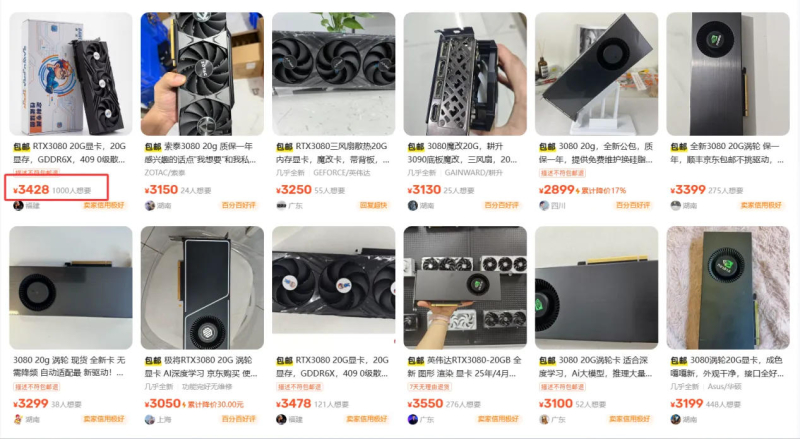
From a technical standpoint, the modified card retains the raw power of the original silicon: 8,704 CUDA cores and a 320-bit memory interface. However, doubling the memory from the base 10 GB to 20 GB removes the model's most painful limitation—one that has become critical by 2026. Nevertheless, this "hardware surgery" comes with a price. Users must contend with high power consumption—hovering around 320W—a total lack of official warranty, and the inability to utilize modern features like DLSS Frame Generation or Multi Frame Generation, which are exclusive to newer generations.
Despite the maturity of the Ampere microarchitecture, Nvidia continues to provide robust software support. This allows older cards to remain relevant; the RTX 30 series regularly receives driver updates and support for new DLSS iterations. Specifically, DLSS 4.5 Super Resolution, featuring a next-generation transformer-based model, operates across all GeForce RTX models, effectively extending Ampere's lifecycle and keeping it competitive even in the era of new releases.
The contrast becomes particularly stark when looking at the current Blackwell series. The pricing situation for new models, such as the GeForce RTX 5070, is alarming: market prices in the US have reached nearly $900, exceeding the MSRP by 64%. In the face of such a pricing gap, a modified RTX 3080 for $445 ceases to look like a questionable compromise and instead becomes a rational choice.
This is not a wholesale replacement for modern solutions, but rather a triumph of engineering ingenuity over market volatility. Ampere, which should have long since been retired, is receiving a second lease on life, proving that strategic hardware modification can be more effective than purchasing an overpriced new product.
 The Price of Acceleration: CXMT’s Rapid Push into Memory