The contemporary high-end GPU market has evolved into a battlefield where corporate rhetoric clashes with the brutal realities of supply and demand. Once the disparity between the suggested retail price and the actual street price hits a breaking point, the very notion of MSRP becomes an exercise in futility. The rollout of the GeForce RTX 50 series underscores a systemic crisis in the accessibility of flagship hardware on a global scale; at this juncture, Nvidia's official pricing serves less as a reliable benchmark for consumers and more as a carefully curated marketing facade.
In the semiconductor industry, there exists an unspoken agreement regarding the Manufacturer's Suggested Retail Price (MSRP), intended to serve as a market anchor. However, with the GeForce RTX 50 series, this mechanism has fundamentally broken down. On official US product pages, the figures remain almost utopian: $299 for the base RTX 5060 and a staggering $1,999 for the flagship RTX 5090. The problem is that these numbers have long ceased to reflect reality, becoming mere formalities that Nvidia maintains despite an obvious market dissonance.
Data from price aggregators reveals that even the most entry-level models in the lineup are trading above their established ceilings. For instance, the GeForce RTX 5060 Ti (8GB), slated for $379, is currently retailing for at least $429.99. But the true scale of the crisis is evident in the high-end segment. The cheapest RTX 5090 offers start at $4,099.99—and that is assuming any stock exists at all. Consequently, the actual cost of the flagship exceeds its MSRP by more than 100%.
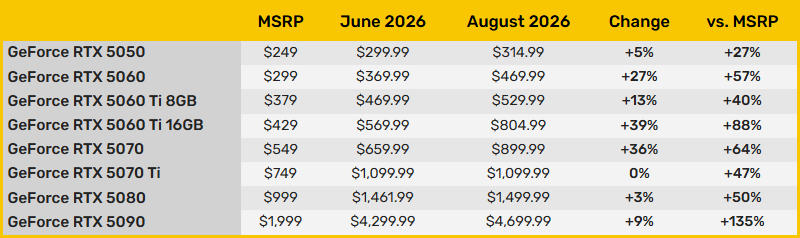
Price dynamics over recent months highlight a troubling trend: GPU costs aren't merely stabilizing at a high plateau; they are continuing to climb. The most aggressive surge is seen in the RTX 5060 Ti (16GB), whose median price skyrocketed by 39% over two months, jumping from $569.99 to $804.99. While the mid-range—represented by the RTX 5070 Ti and RTX 5080—shows relative stability or moderate growth, the flagship RTX 5090 continues to decouple from reality. Since June, its median price has climbed from $4,299.99 to $4,699.99. This means that even in early summer, the card cost more than double its nominal value; today, the premium has reached 135%.
This pricing chasm creates absurd scenarios that have become a focal point of discussion within the enthusiast community. At QuakeCon 2026, Nvidia attempted to partially mitigate the backlash by offering a limited number of Founders Edition cards at MSRP via a "Verified Priority Access IRL" program. For many US users, the math was brutal: the cost of flying across the country and paying for lodging to purchase the card on-site was effectively lower than trying to acquire an RTX 5090 from a local retail store.
From a market strategy perspective, Nvidia's silence is telling. By refusing to announce price revisions, the company formally remains within its stated pricing brackets, shifting all responsibility for "market fluctuations" onto retailers and scalpers. In reality, we are witnessing the transformation of top-tier GPUs from consumer electronics into a kind of investment asset or luxury commodity, where access to hardware is determined less by financial means than by luck and reaction speed.
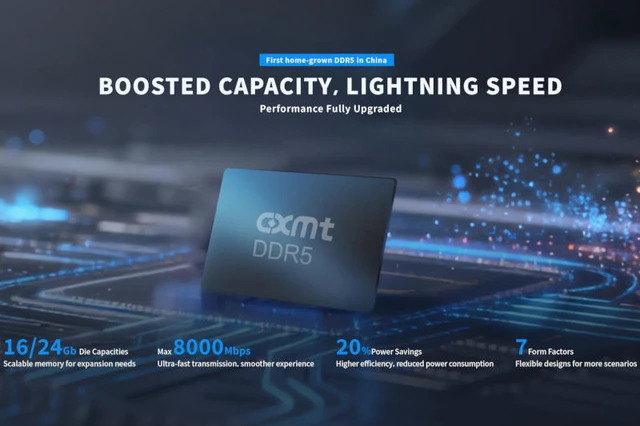 The Price of Acceleration: CXMT’s Rapid Push into Memory