The high-end GPU market is grappling with a new wave of price volatility. A sharp correction in flagship graphics card pricing across one of the world's largest consumer hubs signals fundamental shifts within global supply chains. Major vendors, including MSI and Colorful, have already begun adjusting their price lists for the RTX 5000 series—a move that raises alarms about a potential global trend. This dynamic underscores the mounting pressure currently facing both component manufacturers and hardware OEMs.
The Chinese GPU market has emerged as the primary bellwether for upcoming price shifts in next-generation graphics solutions. Distributors for MSI and Colorful have reported significant price hikes across the entire GeForce RTX 50-series lineup—ranging from the entry-level RTX 5050 to the uncompromising flagship RTX 5090 D V2. This adjustment appears less like a random fluctuation and more like a systemic shift in pricing strategy.
The most pronounced volatility is evident in MSI's high-performance segment. The RTX 5080 Shadow 3X OC and Ventus models have seen a 20% surge, climbing from 9,999 to 11,999 yuan. A similar trend has hit the Gaming Trio OC version, with an increase of 18.2%. Even the mid-range sector, represented by the RTX 5070 Ti, is experiencing a notable spike: prices for the Shadow 3X OC and Gaming Trio OC variants have jumped by nearly 20%.
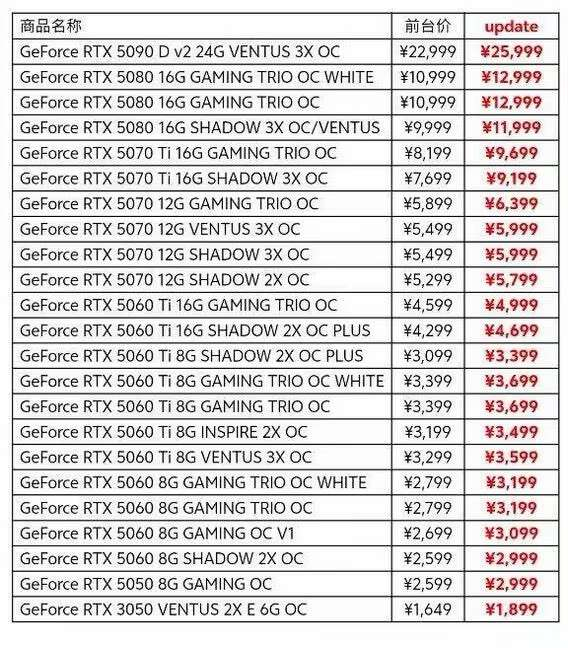
Interestingly, this price correction has also permeated the mainstream consumer sector. Popular models like the RTX 5060 Ti and the base RTX 5060 have increased by an average of 400 yuan. Even the most accessible card in the series—the RTX 5050 Gaming OC—now commands 2,999 yuan, up from its previous 2,599, underscoring the pervasive nature of this trend.
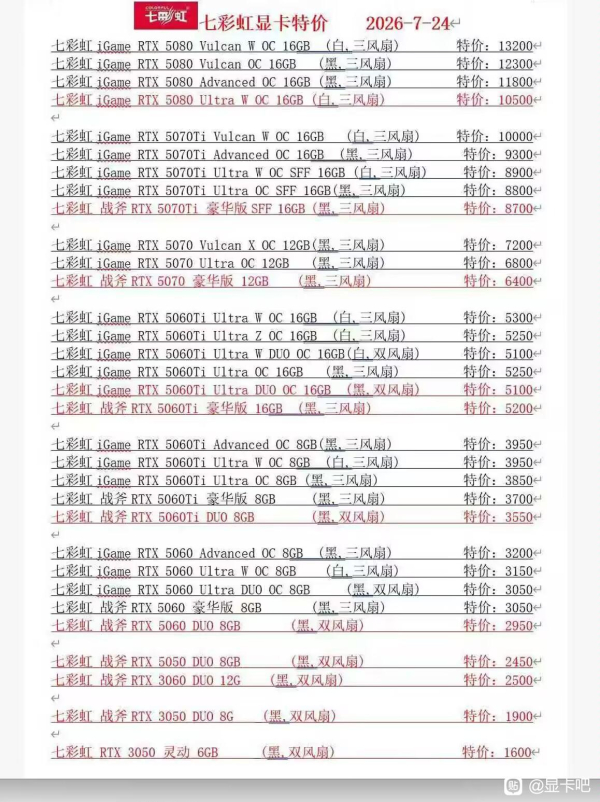
Parallel to this, Colorful has updated its own price lists. In their catalogs, the top-tier RTX 5080 Vulcan W OC is now valued at 13,200 yuan, while the Advanced OC and Ultra W OC versions are priced at 11,800 and 10,500 yuan, respectively. For users targeting the mid-range, RTX 5070 Ti models are now offered in the 8,700 to 10,000 yuan range, while the 16GB RTX 5060 Ti is priced around 5,100–5,300 yuan.
Specific technological and economic drivers underpin this pricing spike. According to internal distributor notices, the primary catalyst for the increase is the rising cost of GDDR6 and GDDR7 memory standards. In the modern GPU industry, memory capacity and type have become critical factors in the Bill of Materials (BOM): the more VRAM integrated into the board, the more severe the price impact.
Specifically, the surcharge correlates directly with memory volume: cards with 8GB saw an increase of approximately 600 yuan, 12GB models rose by 900 yuan, and flagship solutions with 16GB saw a cost increase of 1,200 yuan. This points to either a shortage or an escalation in the production costs of the high-speed memory modules essential for these new architectures.
While these changes are currently limited to the Chinese region, historical precedent suggests that local price adjustments often serve as precursors to global shifts. Should component costs continue to climb, the US and European markets may face similar pricing revisions in the near future.
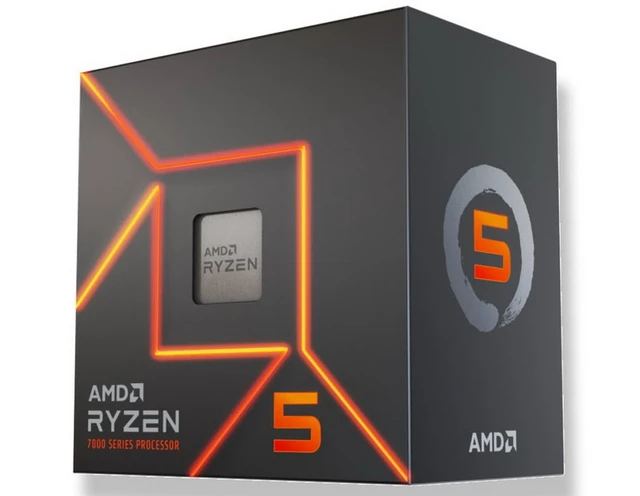 AMD’s Strategic Approach to the Budget Segment