In an era defined by the breakneck evolution of neural networks and ray tracing, the industry frequently overlooks the fundamental requirements of the industrial sector. There are instances where legacy technologies prove more efficient for specialized, niche applications than today's cutting-edge flagships. Biostar has sought to remind the market of the enduring value of time-tested solutions by reintroducing graphics chips from a decade ago into active production. This move highlights a surprising disconnect between the trajectory of consumer gaming and the pragmatic demands of industrial automation systems.
While the global discourse is consumed by teraflops and the ascent of artificial intelligence, a curious regression to the fundamentals is unfolding on the periphery of the market. Biostar has unexpectedly ramped up the promotion of the GeForce GT 730—a graphics card built on Nvidia’s aging Kepler architecture. To the modern consumer, this appears to be a technological relic, given that the chip debuted back in 2014; however, in specific deployment scenarios, this strategy reveals a deep, calculated pragmatism.
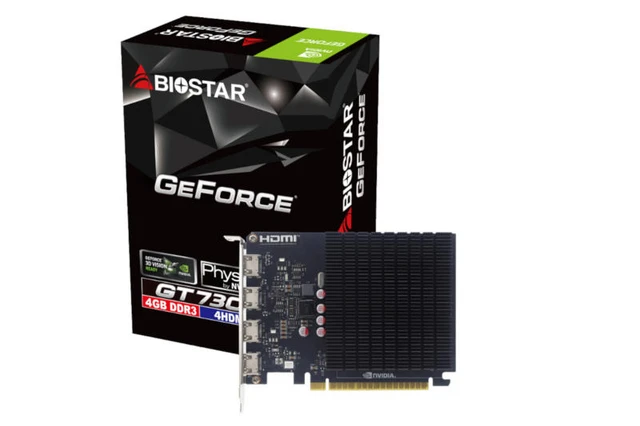
The VN7313TG46 model is a quintessential example of utilitarian hardware. Technically, it leverages 384 CUDA cores clocked at 902 MHz and is equipped with 4 GB of DDR3 memory on a 64-bit bus. Its PCIe 2.0 x8 interface and the absence of a requirement for external power make it exceptionally compatible with a wide array of systems, including legacy industrial platforms.
Yet, the true value proposition lies not in raw computational throughput—which is minimal by contemporary standards—but in its I/O versatility. The card features four HDMI 2.0b outputs, enabling the simultaneous management of four independent displays. While such a configuration is irrelevant for gaming, it becomes a critical advantage for control rooms, surveillance systems, and digital signage.
The market dynamics here are equally intriguing: despite the antiquity of the architecture, the VN7313TG46 only hit the shelves in the spring of 2024. Furthermore, Biostar continues to evolve this line, offering several variations of the GT 730 chip, including the VN7315THX6, which is officially marketed as a "new arrival." This underscores a stable demand for hardware where operational stability and power efficiency take precedence over rendering performance.
Looking ahead toward 2026, such devices are poised to remain relevant. Low power consumption combined with multi-monitor support makes them ideal tools for industrial automation and infrastructure management. It serves as a reminder that within the high-tech ecosystem, there exists a resilient segment where "legacy" is synonymous with "reliable and sufficient."
 The Phenomenon of Chinese 96GB AI Accelerators