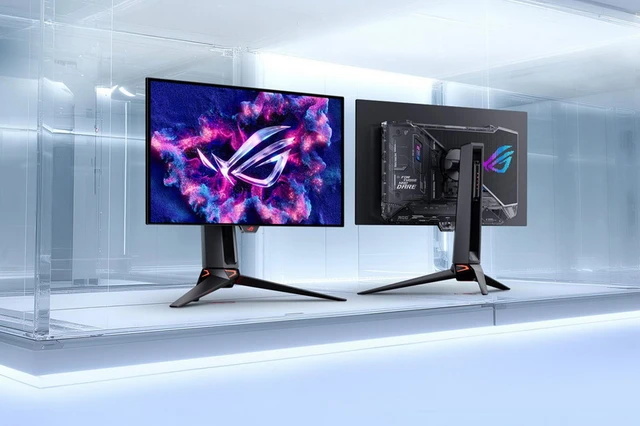
The contemporary gaming display market has reached a critical juncture where traditional panels no longer suffice for the rigorous demands of professional gamers and content creators. The quest for a perfect equilibrium between ultra-high resolution and extreme refresh rates has catalyzed the emergence of new technological standards. The latest ROG Swift OLED models arrive as a definitive answer to this challenge, fusing innovative pixel architecture with intelligent management systems. This is not merely a product refresh; it is an ambitious attempt to redefine the user-screen interface through the lens of AI and energy efficiency.
The monitor industry is undergoing a fundamental paradigm shift where the focus has shifted from mere pixel density to the underlying physics of how those pixels operate. The new ROG Swift OLED series, available in 26.5- and 31.5-inch diagonals, leverages Tandem RGB OLED technology. The defining characteristic here is the implementation of an RGB Stripe OLED structure paired with a TrueBlack Glossy coating, achieving profound black levels and exceptional contrast.
Of particular note is the strategic omission of the white subpixel—a staple of traditional WOLED panels. By implementing True RGB Stripe OLED, ASUS addresses one of the most persistent challenges of organic LEDs: text fringing and color distortion at high brightness levels. The result is a 27% increase in color volume even at peak luminance, rendering the image denser and more natural.
The technical versatility of these panels is realized through two distinct operating modes. For users demanding flawless detail, a 4K mode at a 240Hz refresh rate is available. However, for competitive esports, the display can pivot to Full HD, where the refresh rate surges to 480Hz, ensuring near-instantaneous response times and fluid motion. This visual performance is bolstered by VESA DisplayHDR 400 True Black certification and Dolby Vision support; combined with a peak brightness of 1,000 nits, 99% DCI-P3 coverage, and a Delta E < 2 accuracy, the monitor evolves into a legitimate tool for professional color grading.
To ensure seamless visual stability, modern synchronization protocols—Nvidia G-Sync and AMD FreeSync Premium Pro—are integrated, completely eliminating screen tearing even during volatile FPS swings.
The perennial challenge of OLED technology remains panel degradation, or "burn-in." The solution here is the OLED Care Pro suite, which elevates protection to the hardware level. An integrated proximity sensor monitors user presence: if the screen remains unattended, the system automatically powers down the display or activates a timed background image (adjustable from 1 to 15 minutes).
This engineering rigor extends to the device's internal circuitry. The integration of GaNFET technology within the power supply has optimized thermal dissipation. The use of Gallium Nitride significantly enhances energy efficiency, reducing heat output by nearly 35%—a critical factor in maintaining stable panel temperatures and extending overall lifespan.
The management layer is driven by agentic AI. Rather than navigating cumbersome, multi-level settings menus, users can interact with the monitor using natural language via specialized Display Control CLI and Agent Skill tools. This transforms configuration into a dialogue: the system can autonomously generate lighting profiles. For instance, a morning mode with high brightness and a color temperature of 6500K automatically transitions to an evening preset with an enhanced blue light filter and a 4000K temperature to reduce ocular strain before sleep.
The hardware suite is rounded out by a cutting-edge array of connectivity options. Two HDMI 2.1 FRL ports and DisplayPort 2.1a ensure maximum bandwidth for signal transmission, while USB Type-C with 90W Power Delivery allows the monitor to function as a centralized hub for a laptop, decluttering the workspace from redundant cables.
 The Horizon of China's Technological Sovereignty in Lithography