The shift from automotive dominance to total robotization is no longer a futuristic projection; it has become an industrial reality. Tesla is fundamentally rewriting its manufacturing DNA, sacrificing its luxury-segment legacy to pursue ambitions in embodied AI. The decommissioning of the Model S and Model X lines in Fremont represents more than a mere product refresh; it signals a wholesale shift in the company's technological paradigm. This radical pivot underscores a strategic bet on humanoid robotics as the primary growth engine for the coming decade.
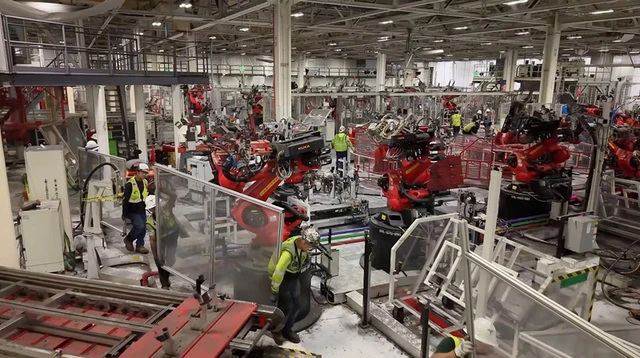
The sweeping transformation of Tesla’s Northern California facility commenced with a dismantling process that was as swift as it was surgical. In a mere 46 days, the production capacities that had defined the modern electric vehicle for decades were effectively erased. The operation mirrored a controlled demolition: heavy machinery tore through concrete foundations, while the robotic manipulators and intricate conveyor systems that once assembled the flagship Model S and Model X were stripped away to make room for a fundamentally different industrial paradigm.
This overhaul represents the logical culmination of a strategy unveiled in early 2026. The decision to phase out the production of luxury sedans and crossovers followed a rigorous analysis of the fourth-quarter results of 2025. The timeline for decommissioning the legacy lines was uncompromising: order intake ceased in April, and the final vehicles rolled off the assembly line in May 2026. A symbolic handover of the final electric vehicle marked the definitive end of an era for these models, clearing the path for a new chapter.
The objective of this radical repurposing is the deployment of specialized production lines for the Optimus humanoid robots. The stated ambitions are staggering: Tesla aims for an annual production capacity of one million units. Achieving such scale, however, necessitates a fundamentally new infrastructure. Unlike automotive assembly, where primary components are static and predictable, the manufacture of androids involves far more complex kinematics, precision actuators, and the integration of sensory systems—all of which demand a completely different approach to assembly automation.
Despite the prevailing optimism and the breakneck speed of the facility's clearance, leadership remains cautious regarding the scaling timeline. The initial ramp-up of Optimus production is expected to be gradual. This is because the creation of a humanoid robot is not merely an iteration of automotive manufacturing, but the development of an entirely new technological stack. Every phase—from component casting to the calibration of balancing systems—must be engineered from the ground up, rendering the process significantly more labor-intensive and risk-prone than launching another generation of electric cars.
Consequently, the events in Fremont signal Tesla’s definitive transition from a traditional automaker to a pioneer of general-purpose robotics and AI systems. By pivoting away from the established luxury transport market, the company is betting on the creation of a new category of consumer and industrial products—one that possesses the potential to fundamentally reshape the structure of global labor.
 The Expansion of Semiconductor Foundry Giants