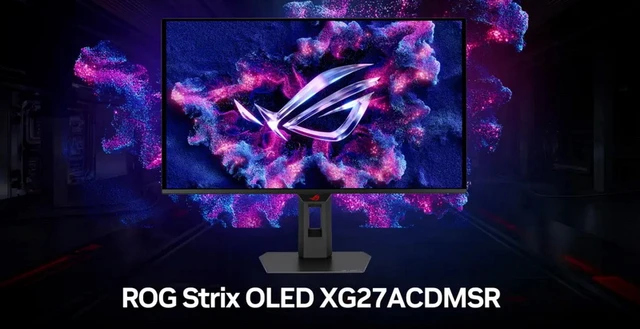
The quest for the ultimate gaming display has entered a new frontier: Tandem OLED. In an era where high refresh rates and deep blacks are considered the baseline, the industry's focus has shifted toward longevity and peak luminance. Asus is now pushing the boundaries of the QD-OLED segment with the introduction of the ROG Strix OLED XG27ACDMSR—a monitor that embodies an uncompromising pursuit of visual fidelity and instantaneous response speeds.
The monitor industry is undergoing a pivotal technological shift, and the debut of the ROG Strix OLED XG27ACDMSR underscores the transition toward Tandem QD-OLED panels. This technology synergizes the advantages of quantum dots and organic LEDs to create a more resilient and luminous display. Effectively an iterative refinement of the XG27ACDMS introduced earlier this spring, the new model demonstrates just how rapidly hardware cycles can raise the performance ceiling.
The most significant upgrade lies in the refresh rate: the display now supports 320 Hz at a resolution of 2560 × 1440 pixels. This provides a perceptible boost in fluidity over the previous 280 Hz, a critical advantage for competitive esports. Parallel to this, there has been a substantial leap in luminance. Typical brightness has climbed to 300 cd/m², while peak brightness in HDR mode reaches 1300 cd/m², ensuring images remain vibrant and detailed even in scenes with extreme contrast.
Particular emphasis has been placed on durability and visual perception. The implementation of a specialized BlackShield coating addresses two fundamental vulnerabilities of OLED panels. First, it increases the screen's resistance to mechanical damage and scratches by 2.5 times. Second, the coating optimizes light reflection, increasing the perceived black level by 40% compared to previous QD-OLED generations. The result is that "infinite contrast" effect highly prized in professional gaming and content creation.
The device's technical specifications are bolstered by VESA DisplayHDR 500 True Black certification and 99% DCI-P3 color space coverage. To ensure seamless frame delivery, the monitor features AMD FreeSync Premium Pro and Nvidia G-Sync compatibility, effectively eliminating screen tearing and input lag.
One of the most pragmatic innovations is the integrated proximity sensor. This system automatically triggers a black screen mode when the user leaves their workstation—a targeted solution to combat the Achilles' heel of OLED technology: pixel burn-in caused by the prolonged display of static interface elements.
In terms of ergonomics and connectivity, the unit is equipped with a modern port array: DisplayPort 1.4 with DSC support, HDMI 2.1, and USB Type-C with power delivery up to 15W. For professional gamers, the monitor includes a screen scaling function that can reduce the active area to 24.5 inches, as well as support for alternative 4:3 aspect ratios, allowing the visual experience to be tailored to the specific requirements of competitive shooters.
While official release dates and pricing remain undisclosed, the ROG Strix OLED XG27ACDMSR clearly defines the trajectory for premium displays: a convergence of extreme speed, deep blacks, and intelligent panel protection systems.
 Forecasting Exponential Growth in Nvidia Shipments