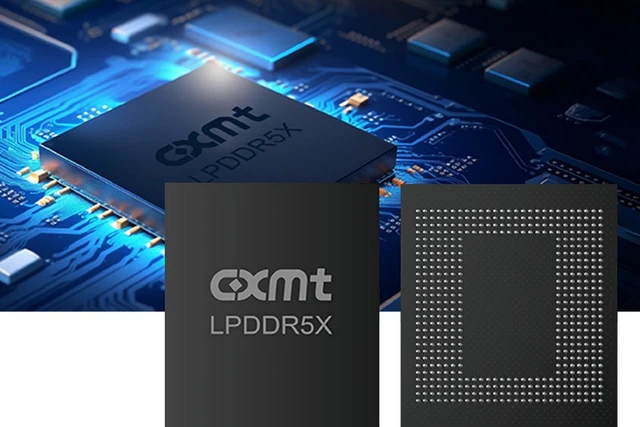
The high-end graphics market is currently grappling with an unforeseen surge in price volatility. Escalating costs for critical components—most notably the latest GDDR7 memory—have begun to directly impact the retail pricing of Blackwell-generation GPUs. Leading Nvidia partners, including Asus, MSI, and Gigabyte, are recalibrating their price points, further elevating the barrier to entry for the premium segment. This trend underscores profound structural shifts in the manufacturing costs associated with modern semiconductor hardware.
The price adjustment for next-generation graphics cards has become the inevitable consequence of rising procurement costs for key components: GPUs and GDDR7 memory modules. This chain of dependency has triggered a sharp surge in market pricing from MSI, Gigabyte, and Asus, with the most pronounced shifts occurring across Asian markets.
Data from the South Korean aggregator Danawa reveals an alarming trajectory: within just a few days, the cost of certain GeForce RTX 5000 series models climbed by anywhere from 3% to nearly 50%. The mid-range segment proved to be the most volatile. For instance, the Gigabyte RTX 5060 Ti 8GB Eagle MAX OC jumped from 472,500 to 706,120 won (approximately $331 to $495), while the MSI RTX 5060 Ti 16GB Ventus 2X PLUS OC saw an even more aggressive spike—from 740,860 to 1,109,280 won ($519 to $777).
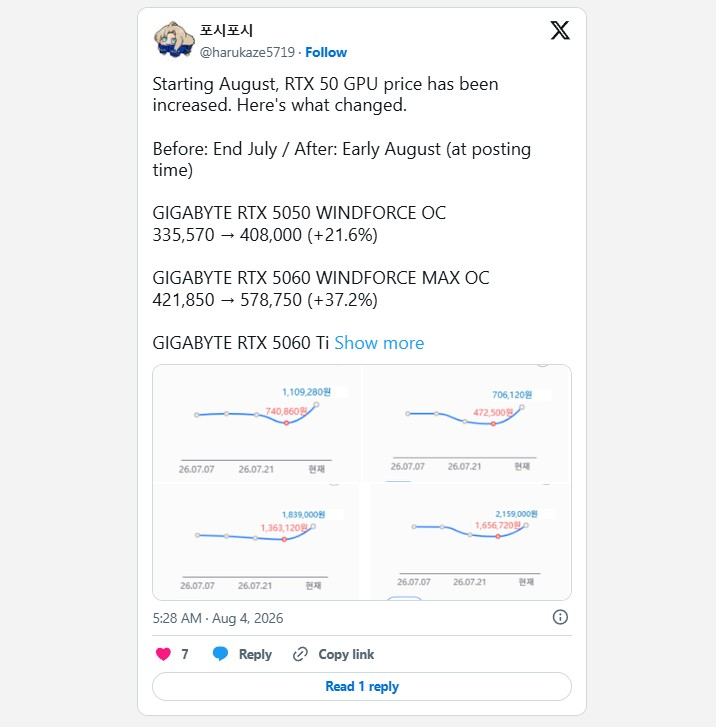
This trend has permeated the entire Blackwell lineup. Average price increases for the RTX 5060 stood at 37.2%, while the RTX 5070 Ti and RTX 5080 rose by 34.9% and 30.3%, respectively. Even the flagship tier was not immune: the Asus GeForce RTX 5090 ROG Astral OC saw a price uptick of about 3%. While seemingly small in percentage, the absolute figures are substantial, with the price climbing from 7.2 million to 7.5 million won (approximately $5,103 to $5,256).
The situation is further complicated by the fact that this price volatility has migrated to the wholesale level. Japanese distributor CFD Sales notified corporate clients of procurement price hikes for Gigabyte products starting in August, with increases ranging from 20% to 40%. This creates a dangerous precedent for the entire supply chain; since major players place their orders through the CFD-BIZ platform, any fluctuations here inevitably trickle down to the retail consumer.
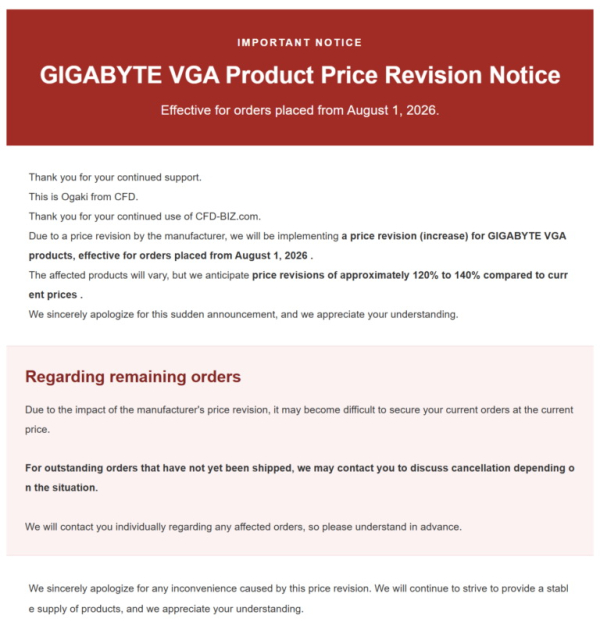
Of particular concern is the policy regarding existing orders. CFD warned that pending transactions could be canceled if the company is unable to secure stock at previous price points. This implies that even a confirmed order does not guarantee a locked-in price, and each case will be handled on an individual basis.
Such frictions are already manifesting in the real world. A Reddit user reported a scenario where their order for a flagship Asus GeForce RTX 5090 ROG Astral OC was voided immediately after checkout. Despite an initial price of $4,607 (including taxes), Nvidia support cited a request from the manufacturer, Asus, as the reason for the cancellation. Ultimately, the same card was relisted at a price nearly 12.5% higher, bringing the final bill to $5,100.
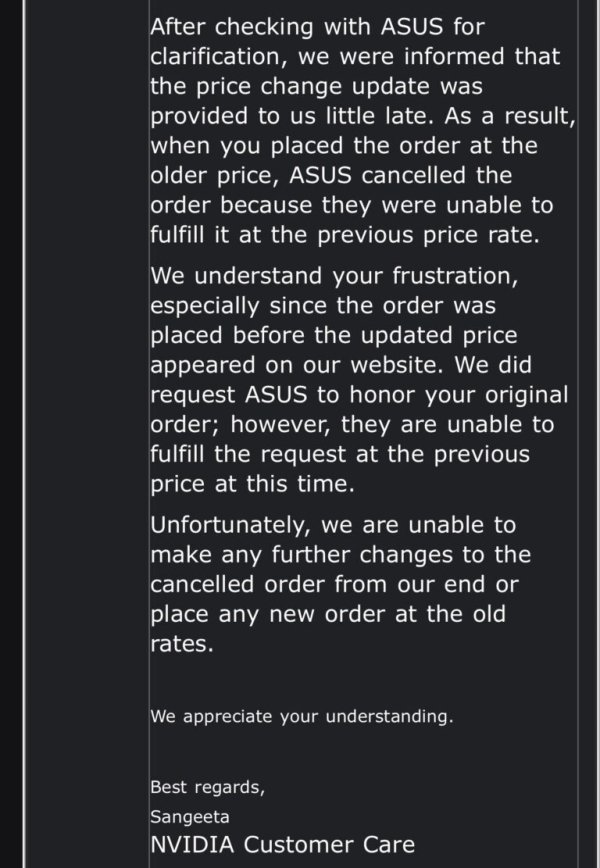
This incident exposes a significant conflict of accountability between the vendor and the distributor. While Nvidia attempted to deflect blame for the cancellation onto Asus, the manufacturer effectively refused to honor the original pricing commitment. From a legal standpoint, such practices could be viewed as a violation of consumer rights in several jurisdictions; however, in practice, the buyer is left at the mercy of harsh market dynamics where component costs dictate the rules of engagement.
 Breaking the Lithography Barrier in China