The contemporary gaming hardware landscape is increasingly bifurcating into two distinct poles: the ultra-premium segment and hyper-accessible solutions tailored for entry-level users. In this relentless pursuit of price competitiveness, technical specifications—often opaque to the casual consumer—are frequently the first casualties. AMD's latest GPU rollout serves as a prime example of how manufacturers engineer specialized hardware exclusively for system integrators. The debut of the Radeon RX 9050, characterized by its truncated memory capacity, highlights a calculated strategy of adapting product specs to fit the rigid budgetary constraints of the OEM market.
The GPU market is no stranger to various iterations of the same model, yet AMD has opted for a strict demarcation between its retail offerings and partner-specific solutions. The confirmation of a 4GB VRAM variant of the Radeon RX 9050 caught many by surprise, as this card was never intended for standalone retail sale. Instead, it is designed exclusively for OEMs and system integrators aiming to provide the lowest possible entry point into the world of gaming.
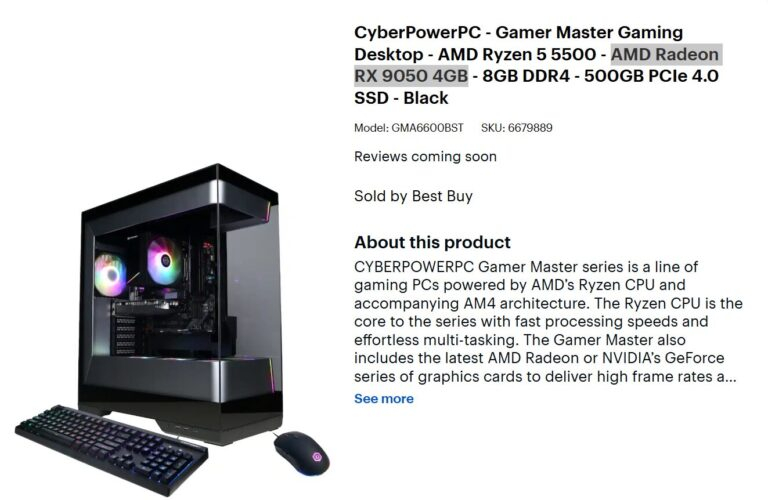
A tangible manifestation of this strategy is an entry-level gaming rig from CyberPowerPC, recently spotted at Best Buy. The Gamer Master GMA6600BST is a textbook example of budget balancing: it centers on a Ryzen 5 5500 processor, paired with a modest 8GB of DDR4 RAM and a 500GB SSD. Priced at approximately $900, the system is positioned for the mass market, though its pricing raises critical questions regarding the actual performance viability of the graphics core in today's demanding environment.
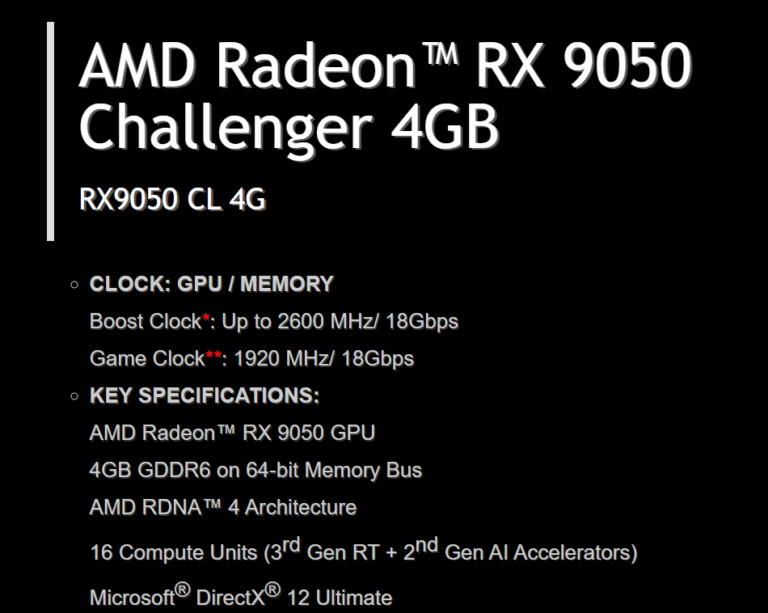
Technical analysis reveals that the disparity between the full-fledged RX 9050 and its OEM counterpart extends beyond mere capacity. While the standard model features 8GB of GDDR6 memory with a 18 Gbps effective clock speed and a 128-bit bus, the 4GB version has undergone more aggressive streamlining. According to data from ASRock, the memory bus width in this modification has been slashed to 64-bit.
This architectural shift results in a critical plunge in bandwidth: dropping from 288 GB/s in the full version to just 144 GB/s in the stripped-down variant. For the end user, this translates to significant constraints when handling heavy textures and lower resolutions, as the memory bottleneck becomes the primary performance limiter—even if the GPU's raw computational power remains acceptable. Despite boasting 1024 stream processors and 16 compute units, this specific memory configuration effectively relegates the card to basic tasks and less demanding esports titles.
 Virtual Gamepads within the Google TV Ecosystem