The gaming industry is rapidly approaching the threshold of human perception regarding motion fluidity. Samsung’s upcoming Odyssey lineup, slated for 2027, is poised to redefine the benchmarks for refresh rates and panel longevity. From ultra-wide OLED displays to a staggering 1100 Hz, the company is showcasing a masterclass in the synergy between materials science and electronic engineering. This leap heralds a new era of visual immersion, one where technical latency becomes virtually imperceptible.
The high-performance display market is undergoing a fundamental paradigm shift; the battle is no longer fought over raw resolution, but rather over response speeds and image purity. Samsung is doubling down on a radical overhaul of its flagship series, delivering solutions that push the boundaries of what is possible for professional esports athletes and enthusiasts alike.
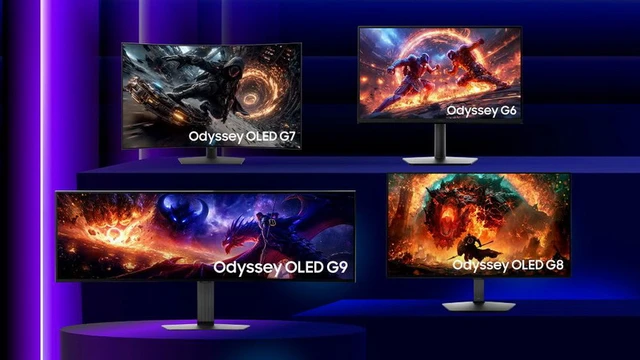
The centerpiece of this evolution is the Odyssey OLED G9 (G95SJ). This 49-inch behemoth, featuring DQHD resolution (5120 × 1440 pixels) and a 360 Hz refresh rate, is an uncompromising tool for total immersion. However, the model's true value lies in its technological stack: it utilizes a QD-OLED matrix featuring an innovative Penta Tandem structure. This five-layer panel architecture boosts power efficiency by 30% and, more critically for OLED technology, doubles the display's lifespan by significantly mitigating the risk of burn-in.
To combat the perennial Achilles' heel of OLED panels—text fringing and chromatic aberration—Samsung has implemented an RGB Stripe subpixel structure. This ensures crystalline text clarity, effectively transforming a gaming monitor into a fully capable professional workstation. Peak brightness reaches an impressive 1,300 nits, guaranteeing vibrant imagery even under intense ambient lighting. Furthermore, the device offers remarkable flexibility: by scaling resolution down to 2560 × 720 pixels, the refresh rate skyrockets to 720 Hz, opening new horizons for ultra-fast dynamic scenes.
In the 32-inch segment, the Odyssey OLED G8 (G80SJ) takes center stage. Its defining characteristic is versatility. The monitor supports three distinct operating modes, allowing users to choose between flawless 4K at 360 Hz, a balanced QHD at 520 Hz, or an extreme FHD at 680 Hz. It is powered by the same Penta Tandem technology, while visual comfort is ensured by a specialized Samsung Glare Free coating, which is 54% more effective at suppressing reflections than standard anti-glare filters.
The G8's technical specifications underscore its premium positioning. Support for VESA DisplayHDR TrueBlack 600 guarantees deep, absolute blacks, while compatibility with AMD FreeSync Premium Pro and Nvidia G-Sync eliminates screen tearing. The connectivity suite features a cutting-edge DisplayPort 2.1 with UHBR20 support, essential for the lossless transmission of massive data streams. The inclusion of USB-C with 98W power delivery and an integrated KVM switch makes it an ideal command center for managing multiple devices.
For those seeking maximum immersion, Samsung introduces the Odyssey OLED G7 (G75SJ). This is a pioneer in its class: a 42-inch curved OLED monitor with a classic 16:9 aspect ratio. The 1000R radius of curvature closely mimics the natural human field of vision, which, combined with 4K resolution and a 165 Hz refresh rate, creates a profound sense of presence within the virtual space.
Rounding out the lineup is the Odyssey OLED G6 (G60H)—a device that sets a new global benchmark for refresh rates. In HD mode (720p), the monitor can operate at a staggering 1100 Hz, and 600 Hz in QHD mode. Unlike the OLED models, this unit employs a Fast IPS matrix with a 1ms response time. This approach achieves extreme motion fluidity, which is critical in competitive FPS titles where every millisecond counts. This model is expected to hit the market in the second half of 2026, firmly cementing Samsung's leadership in the race for speed.
 The Pinnacle of Clarity: AOC's New 5K Monitor