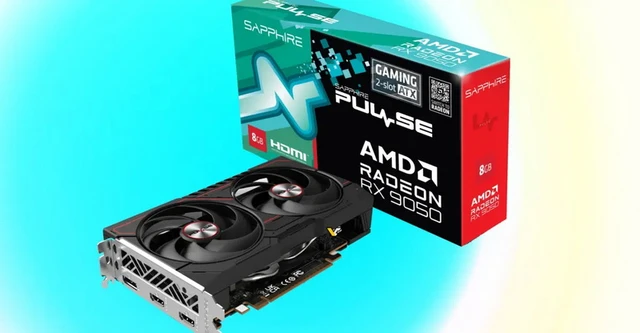
The entry-level GPU market is currently undergoing a fundamental shift, where efficiency and intelligent scaling are eclipsing raw computational power as the primary metrics of success. As the industry pivots toward the RDNA 4 architecture, the objective has shifted toward ensuring a seamless Full HD gaming experience without excessive power draw. Sapphire presents its vision for this segment with the Radeon RX 9050 Pulse—an optimized solution tailored for the mainstream user. This card is designed to prove that even entry-level hardware can embrace an uncompromising approach to thermal management and factory overclocking.
The new Radeon RX 9050 Pulse is powered by an RDNA 4-based GPU, embodying AMD's modern philosophy of balancing raw performance with energy efficiency. Its technical arsenal features 16 Compute Units and 1,024 stream processors. Of particular note is the 32 MB of Infinity Cache—a critical mechanism designed to offset the limitations of the 128-bit GDDR6 memory bus operating at 18 Gbps, ensuring high data throughput within the chip.
Sapphire has pushed beyond reference specifications by implementing an aggressive factory overclock. The GPU's gaming clock has been bumped to 2260 MHz, up from the standard 1920 MHz, while the Boost clock reaches 2760 MHz, comfortably exceeding the baseline of 2600 MHz. To maintain stability at these elevated frequencies, the Thermal Design Power (TDP) has been increased to 100W, an 8W bump over the reference value.
The thermal engineering transforms this card into a benchmark of reliability for its class. The cooling solution relies on dual fans and composite heat pipes that efficiently dissipate heat from the die. A standout technical advantage is the integration of Honeywell PTM7950 phase-change thermal material. Unlike traditional thermal pads, this material changes its state upon heating, ensuring maximum contact and minimal thermal resistance between the GPU and the heatsink. The design is rounded out by a rigid metal backplate, which prevents PCB flexing and contributes to overall heat dissipation.
Power delivery is handled by a digitally controlled seven-phase VRM, ensuring clean current delivery even under peak loads. The card utilizes a single standard 8-pin PCIe connector, with a recommended power supply unit (PSU) of 650W. In terms of connectivity, the card is fully future-proofed: PCIe 5.0 x16 support ensures maximum compatibility with modern motherboards, while the inclusion of DisplayPort 2.1a and two HDMI 2.1b ports provides access to the latest imaging standards.
The market positioning of the Radeon RX 9050 Pulse is precise: it is a tool designed for confident 1080p gaming at medium to high settings. However, its true potential is unlocked through the software stack. Support for FSR 4, AFMF 2, and Anti-Lag 2 allows for a significant increase in frame rates and a reduction in input latency, transforming this budget-friendly solution into a fully capable gaming instrument. Furthermore, the implementation of FSR Redstone further optimizes image processing, delivering a sharper and more stable picture even during intensive upscaling.
 Virtual Gamepads within the Google TV Ecosystem