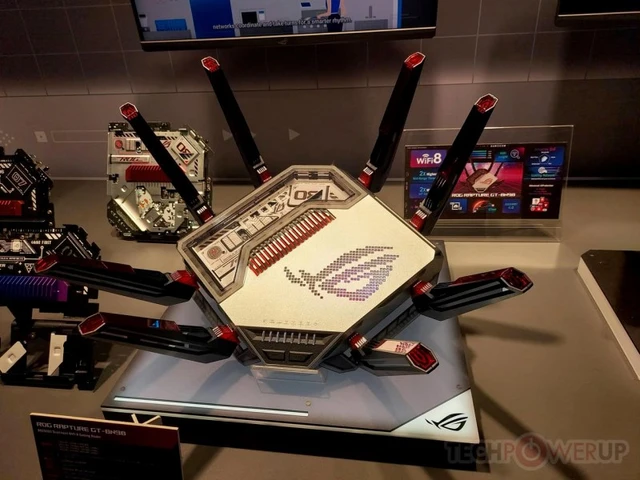
The demands for ultra-low latency and massive network throughput have reached a critical juncture, driven by the rapid evolution of cloud gaming and VR technologies. Legacy wireless standards frequently act as the primary bottleneck, throttling performance even in the most high-end gaming rigs. Asus aims to shatter this ceiling with the introduction of its first device supporting the cutting-edge Wi-Fi 8 standard. The ROG Rapture GT-BN98 heralds a new era of truly multi-gigabit home networking, engineered to redefine the very concept of network infrastructure for the most discerning power users.
The debut of the ROG Rapture GT-BN98 at Gamescom 2026 marked a pivotal moment in networking, effectively heralding the dawn of the Wi-Fi 8 era (802.11bn Draft). While previous iterations of wireless standards focused on incremental speed gains, the eighth generation aims for a radical leap in spectral efficiency and jitter reduction—factors that are mission-critical for competitive gaming.
The device's hardware foundation is impressively robust. Under the hood, a quad-core processor clocked at 2.6 GHz, paired with 2 GB of RAM and 256 MB of flash memory, is capable of handling massive data throughput without packet loss. The most striking visual element is the array of eight external antennas, engineered to ensure maximum coverage and signal stability even within the challenging interference of dense urban environments.
The router boasts a formidable aggregate throughput of 25 Gbps. The distribution across bands reveals a strategic approach to optimization: the legacy 2.4 GHz segment provides 1,276 Mbps, while two 5 GHz bands deliver 5,764 Mbps each. However, the true technological breakthrough lies in the 6 GHz band, which supports 320 MHz channel widths to achieve speeds of up to 11,529 Mbps. This bandwidth effectively renders the wireless connection a viable alternative to a physical fiber-optic cable.
The wired infrastructure of the GT-BN98 is meticulously engineered to ensure it does not become a bottleneck for the wireless interface. The router is equipped with 10 Gbps WAN/LAN and LAN ports, allowing it to integrate seamlessly into the most advanced network topologies. Additionally, it features 2.5 Gbps ports, standard Gigabit LAN, and USB 3.2 Gen 1 and USB 2.0 interfaces for external storage or network services. Versatile configuration options allow the device to function not only as a primary gateway but also as an AiMesh node, an access point, or a media bridge.
The intelligent management layer is powered by the Adaptive QoE suite, which dynamically redistributes network resources to prioritize gaming traffic during peak loads. Simultaneously, the Wi-Fi Insight system performs continuous spectrum monitoring, identifying and bypassing background interference in real time. Particularly noteworthy is the integration of GTNet—a specialized tool that optimizes packet routing to gaming servers by selecting the most stable and shortest path.
Security and network segmentation are handled via the AirProtection system, which manages ad-filtering and tracker blocking at the network level. To manage smart home ecosystems and ensure privacy, the Guest Network Pro feature has been implemented. This allows for the creation of up to five independent SSIDs, enabling the isolation of IoT devices, the configuration of dedicated VPN tunnels, or the implementation of strict parental controls without impacting primary work and gaming profiles.
 Garmin Fenix 9: Setting a New Standard for Sports Watches