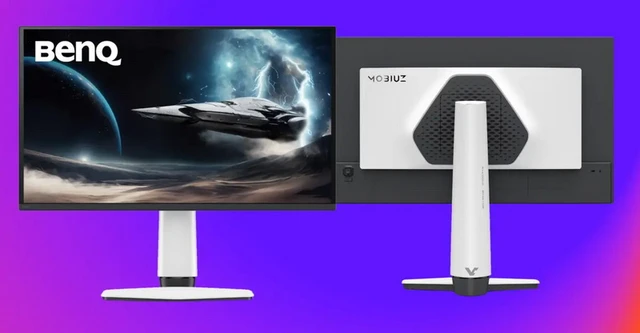
The high-performance display market is undergoing a fundamental transformation, with response times and color purity emerging as the primary benchmarks of quality. Once the sole province of the ultra-premium tier, QD-OLED technology is steadily democratizing, evolving into an accessible tool for gamers and content creators alike. BenQ’s latest offering, the MOBIUZ EX271QMZ, seeks to recalibrate the equilibrium between price point and technical sophistication. This monitor represents a strategic attempt to marry uncompromising speed with long-term reliability—addressing the inherent vulnerabilities that have historically plagued organic panels.
Modern gaming demands more than just high refresh rates; it requires absolute frame clarity. At the heart of the MOBIUZ EX271QMZ lies a third-generation QD-OLED panel featuring a "tandem structure." In industry terms, this approach optimizes the emitter layers to achieve more efficient light management and enhance overall panel stability. With an actual diagonal of 26.5 inches and a 1440p resolution, the device hits the "sweet spot" of contemporary gaming, delivering high pixel density without placing an undue burden on the GPU.
The monitor's technical specifications are unapologetically high-end: a 240Hz refresh rate paired with a 0.03ms (GtG) response time virtually eliminates motion blur in fast-paced scenes. This makes the device an ideal tool for competitive esports, where milliseconds often dictate the outcome of a match. Color reproduction is equally impressive—99% DCI-P3 coverage ensures deep, saturated, and accurate hues, which is critical not only for immersive gameplay but also for basic color correction tasks.
The Achilles' heel of OLED technology has always been organic LED degradation, commonly known as "burn-in." BenQ addresses this issue through a comprehensive strategy. The design integrates a specialized graphene film that effectively dissipates heat, preventing localized overheating of the matrix. This is complemented by a software protection suite including Pixel Refresh and Pixel Shift for uniform pixel wear, as well as Idle Dimmer and Logo Dimming to reduce the brightness of static interface elements.
The visual experience is further elevated by HDR10 support and a staggering 1,500,000:1 contrast ratio, enabling true blacks and meticulous detail in the shadows. While typical brightness sits at 200 cd/m², it peaks at 400 cd/m² in HDR modes. Particularly noteworthy is the proprietary Brightness Flow technology; it analyzes the image in real-time to smooth out abrupt brightness transitions, significantly reducing eye strain during extended gaming sessions.
In terms of ergonomics and connectivity, the monitor fully aligns with modern standards. Dual HDMI 2.1 ports and DisplayPort 1.4 ensure compatibility with current-gen consoles and high-performance PCs. A USB-C port with 15W charging allows for peripheral or mobile device connection, though this power output serves as an auxiliary convenience rather than a full-scale power delivery station. The design is rounded out by an ergonomic stand and VESA 100 × 100 mm compatibility for arm mounting.
The market debut of the MOBIUZ EX271QMZ, priced around $500, puts significant pressure on the competition. BenQ has successfully packaged cutting-edge QD-OLED capabilities into an accessible format, while providing a three-year warranty—effectively neutralizing the primary concerns regarding the longevity of OLED panels.
 The Price of Acceleration: CXMT’s Rapid Push into Memory