The debut of the Zilog Z80 in the mid-1970s served as a catalyst for a profound revolution across both personal computing and the gaming industry. This 8-bit silicon powerhouse defined the architecture of home computers and arcade machines for decades, laying the groundwork for an entire generation of digital culture. Today, as official industrial production draws to a close, the chip's legacy is transitioning into the stewardship of the enthusiast community. The story of the Z80 is a journey from a daring engineering venture to its current standing as an open standard of digital immortality.
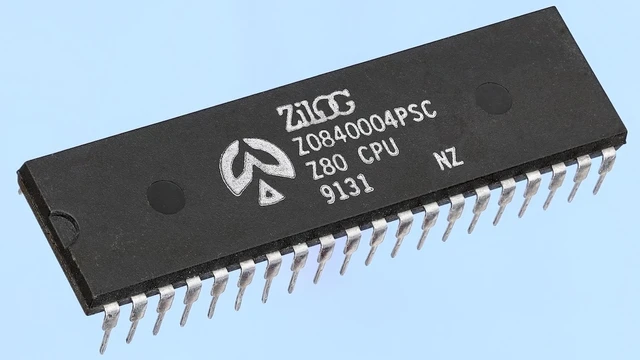
Launched in July 1976, the Zilog Z80 emerged as one of the most influential components in the history of microelectronics. By modern standards, its lifecycle was nothing short of phenomenal: the chip remained in production for nearly 48 years, with the company finally ceasing orders only in June 2024. The Z80's footprint was ubiquitous—powering iconic home systems like the ZX Spectrum, MSX, and TRS-80, as well as legendary gaming consoles such as the Nintendo Game Boy, Sega Master System, and the handheld Sega Game Gear. Even the golden age of arcade halls, including the seminal Pac-Man, would have been unthinkable without this silicon heart.
The technical triumph of the Z80 was driven by a calculated blend of innovation and pragmatism. The original die featured 8,500 transistors fabricated on a 4 $\mu$m process. While it debuted with a standard clock speed of 2.5 MHz, later CMOS versions pushed those limits up to 20 MHz. A pivotal strategic masterstroke was its binary compatibility with the Intel 8080; this allowed the Z80 to instantly leverage the existing software ecosystem of the CP/M operating system, effectively securing its market dominance. Furthermore, the integration of a built-in dynamic memory (DRAM) refresh controller significantly reduced the number of peripheral chips required on the motherboard, simplifying system design and lowering production costs. Notably, developing the first working prototypes required approximately $400,000, backed by total funding of half a million dollars from the Exxon Corporation.
As the era of home computing transitioned into an age of high-performance systems, the Z80 did not vanish; instead, it migrated into the realm of industrial automation. For decades, it remained a staple of embedded controllers due to its legendary reliability and predictability. However, time eventually took its toll: in the spring of 2024, the end-of-life announcement for the Z84C00 family signaled the official conclusion of the classic Z80 era.
Parallel to this, Zilog began pruning its line of successors. Last October, production was halted for the eZ80L92 and several microcontrollers in the Z8F series. Nevertheless, the pipelined eZ80 modification, introduced back in 2001, remains in catalogs and continues to see active use—most notably in modern TI-84 Plus CE calculators. The decline of Zilog as an independent player culminated in 2017, when the company and its parent, IXYS Corporation, were acquired by Littelfuse for $750 million.
Despite the cessation of commercial sales, the Z80 has found a second life through the Open Hardware movement. The FOSSi Z80 project has set an ambitious goal: to create a fully open-source replacement for the original chip in a classic 40-pin DIP package. Development has evolved through several iterations, moving from early, microscopic implementations on the SkyWater 130nm process (with a die area of just 0.064 $\text{mm}^2$) to versions housed in QFN64 packages.
The current phase of the project leverages Chip-on-Board mounting technology and the GlobalFoundries 180nm process via the Wafer.Space platform. At its core lies the Verilog TV80 kernel, enabling impressive performance metrics: modern CMOS implementations can operate at frequencies up to 50 MHz—more than ten times the capability of the original NMOS chip. This initiative does more than just satisfy the nostalgia of retro-enthusiasts building RC2014 kits or restoring ZX Spectrums; it transforms the Z80 into an eternal educational tool, accessible to anyone seeking to master the fundamentals of computer architecture.
 Energy Autonomy: The Extreme Edition