The high-performance hardware market is no stranger to volatility, but the current state of Nvidia's flagship offerings has reached a point of sheer absurdity. A combination of supply shortages and aggressive retail pricing has triggered anomalies that defy the fundamental logic of consumer behavior. In the US, the pricing of top-tier GPUs has completely decoupled from reality, transforming the acquisition of individual components into an unjustifiable luxury. We have reached a surreal tipping point where assembling a complete gaming rig is often more cost-effective than purchasing its single most critical component.
The contemporary GPU market is currently grappling with a paradox that resembles a pricing glitch but is, in reality, a symptom of a profound imbalance between supply and demand. In the North American segment, a bizarre scenario has emerged: purchasing a pre-built branded PC featuring a flagship GeForce RTX 5090 has become more financially viable than acquiring the graphics card as a standalone component.
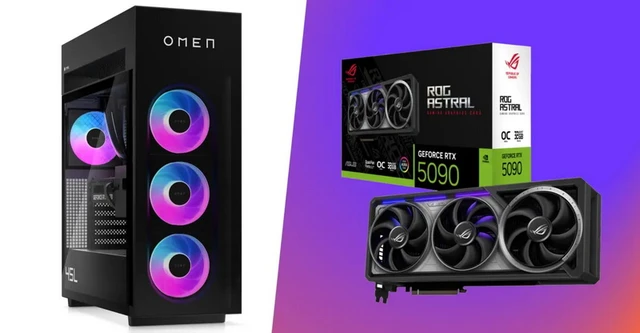
A prime example of this market dysfunction is the HP Omen Max 45L. This turnkey system, equipped with the powerhouse GPU, is listed at $4,709.99. Meanwhile, searching for the same card through retail channels yields results that would stagger even the most seasoned enthusiasts: the most accessible RTX 5090 model currently retails for $4,829.99.
Analyzing the HP system's composition reveals that the buyer isn't just getting a GPU, but a comprehensive high-performance ecosystem. The Omen Max 45L specifications include a modern AMD Ryzen 7 9700X processor, 32GB of DDR5 RAM clocked at 6000 MHz, and a high-speed 1TB PCIe 4.0 NVMe drive. Furthermore, the price covers the motherboard, power supply, an efficient cooling solution, the chassis, and a licensed copy of Windows 11. Effectively, the user receives the rest of the computer "for free," while saving approximately $120 compared to buying the accelerator alone.
The pricing dynamics of the RTX 5090 reveal an alarming trend. According to data from the PCPartPicker aggregator, finding the card in stock is nearly impossible. At one stage, the only available option was the Asus ROG Astral GeForce RTX 5090 OC. Its price trajectory has been staggering: while Nvidia set the Manufacturer's Suggested Retail Price (MSRP) at $1,999, the price had already climbed to $2,799 at launch. Today, the cost of this device has surged by more than $2,000 over the base price, hitting the $4,829.99 mark.
Such a price spike cannot be attributed to mere scarcity. We are witnessing the convergence of several critical factors: limited production volumes of flagship chips, surging demand from the professional sector, and speculative maneuvering by retailers. When the cost of a single component begins to exceed the price of an entire system, the market enters a state of irrationality. In this climate, opting for a pre-built solution becomes the only logical path to achieving maximum performance, as assembling a PC from individual components has evolved into an economically untenable endeavor.
 A New Memory Paradigm for AI Accelerators