The contemporary semiconductor landscape is currently mired in turbulence, as the relentless pursuit of nanometer shrinkage becomes increasingly prohibitively expensive. While Apple has long pursued a strategy of technological hegemony, each incremental leap toward perfection now demands staggering capital expenditure in hardware development. The forthcoming iPhone 18 Pro Max is poised to become one of the most costly devices ever manufactured in the company's history. This surge in component costs presents Cupertino with a stark dilemma: absorb the hit to its profit margins or pass the financial burden onto the consumer.
A production cost analysis conducted by experts at Counterpoint Research suggests a seismic shift in the economics of Apple's flagship devices. Preliminary estimates indicate that the bill of materials (BOM) for the iPhone 18 Pro Max could surge by approximately $300 compared to the previous generation. This spike is no accident; it is driven by a fundamental overhaul of the hardware stack, where the cost of specific components is beginning to dominate the device's overall budget.
The primary catalyst for this price hike is the so-called "silicon triangle": the processor, RAM, and flash storage. In the 1TB configuration, these three components alone could cost as much as the entire set of parts for last year's flagship, including the expensive OLED display and the sophisticated camera array.
Particularly noteworthy is the transition to a 2-nanometer process. Moving to such minuscule transistor scales necessitates the implementation of cutting-edge lithography and innovative chip packaging technologies, inevitably driving up the per-unit cost. Coupled with a global shortage and a sharp rise in memory chip prices, this creates unprecedented strain on the development budget.
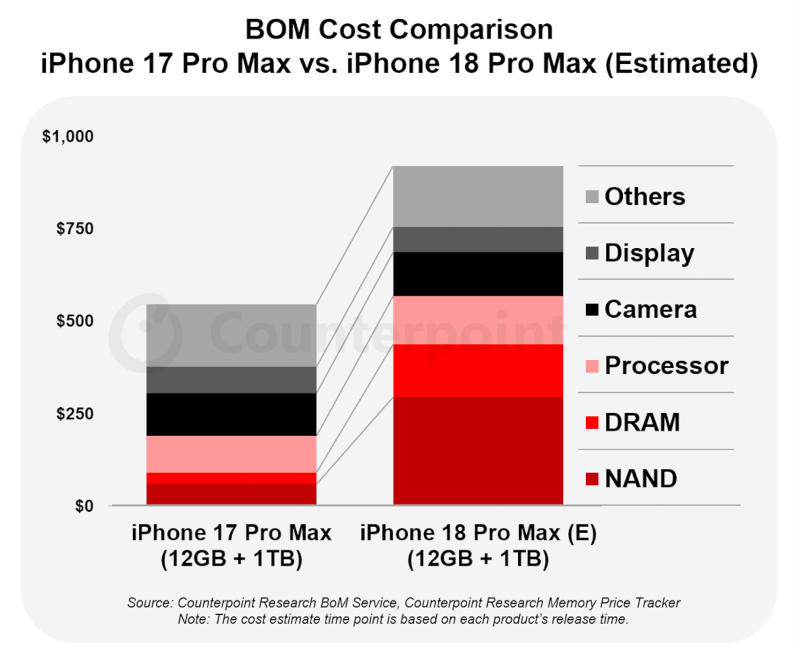
Beyond raw computing power, Apple plans to overhaul its imaging system. The main camera is expected to feature a variable aperture—a solution that significantly complicates the module's architecture and increases its cost. To some extent, this is offset by optimizations in display production, which analysts predict will become slightly cheaper as the technology matures.
However, even partial savings on screens do not solve the core issue: the widening gap between production costs and the retail price. Preliminary data suggests Apple may raise the end-user price by $200. This implies that the company will be unable to fully pass the increased costs on to the consumer, leading to a predictable contraction in gross margins.
To mitigate these losses, Cupertino will likely employ a tiered pricing strategy. Retail price increases may be distributed unevenly across different storage capacities. Consequently, models with maximum storage could see a more significant price jump to preserve the customary profit margins in the ultra-premium segment.

 Nvidia’s Bet on Perpetual Growth