The stability of global open-source projects often hinges upon a rigorous adherence to code management discipline. Even foundational systems like FreeBSD are not immune to infrastructure paralysis triggered by a single erroneous commit. A recent incident involving the ports tree underscored just how precarious synchronization processes can become when colliding with the hard limits of modern platforms. A flaw in a single package resulted in a total repository freeze, necessitating an extensive scrubbing of the version history.
The FreeBSD community recently encountered an unforeseen technical glitch that brought the ports tree—the system's critical mechanism for software compilation and installation—to a temporary standstill. The culprit was a common yet critical error: a binary file weighing approximately 150 MB was accidentally integrated into the repository. In the realm of source control, such volumes for a single file are unacceptable, particularly for systems that rely heavily on mirroring.
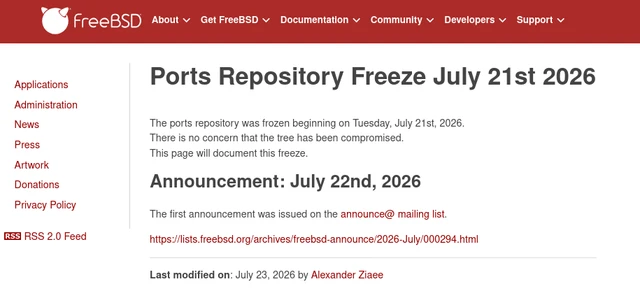
The primary casualty was synchronization with GitHub. Because the platform enforces a strict 100 MB limit per object, the introduction of a 150 MB file instantly paralyzed the mirror update process. This triggered a domino effect: the mirroring infrastructure ceased to function, necessitating emergency intervention from developers and a total freeze on all ports tree modifications for several days.
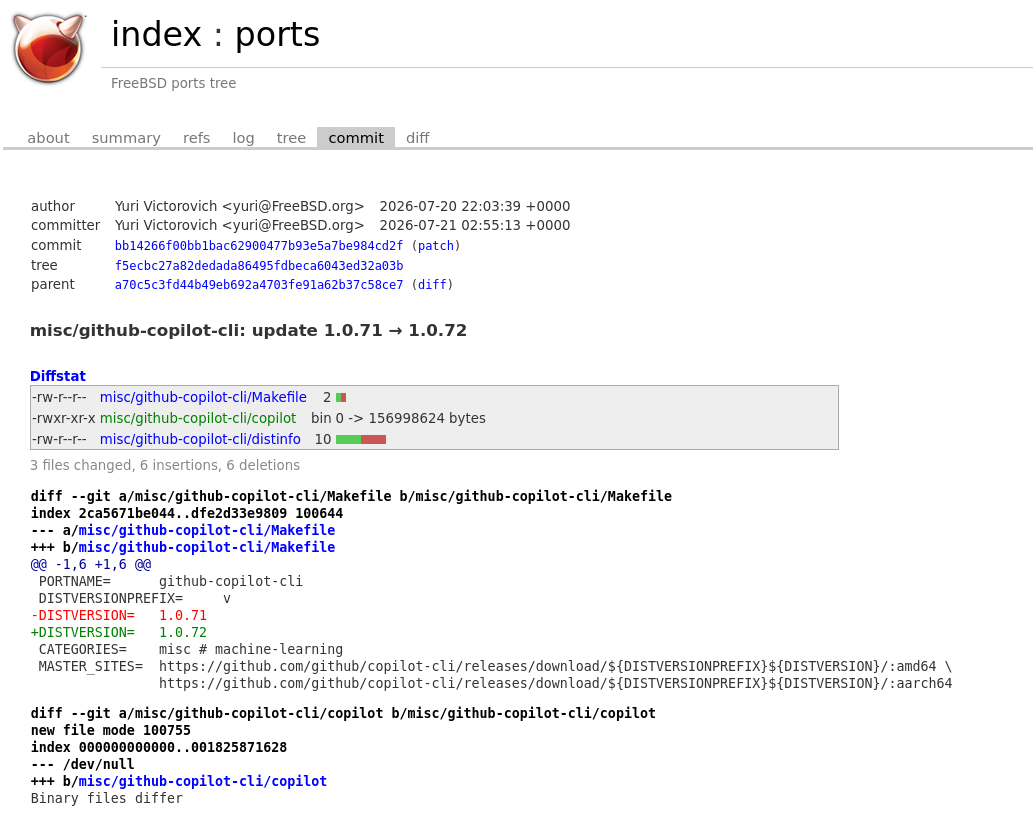
An investigation revealed that the incident was not the result of an external attack or malicious breach. Instead, the issue surfaced during an update to the github-copilot-cli port—a command-line tool for interacting with the GitHub Copilot service. The nature of this product is such that it is distributed exclusively as closed binary builds for Linux, without providing source code.
To enable this utility on FreeBSD, the Linuxlator compatibility layer was employed. Under normal operating conditions, the port should download the necessary builds directly during installation on the user's local machine. However, during the transition to version 1.0.72, a failure in the packaging logic occurred: the copilot executable, weighing 149 MB, was committed directly into the ports tree and etched into the commit history.
The situation was complicated not only by the technicality of the file size but also by significant legal risks. Placing a proprietary binary with an ambiguous license into an open repository required the FreeBSD team to perform a thorough "purge" of the history. Removing such data from a Git repository is a laborious process, requiring a rewrite of the commit history to ensure all traces of the heavy file are completely erased so that mirrors can synchronize once again.
This incident serves as a stark reminder that even in mature projects, the intersection of automation and human error can lead to unexpected consequences. When the boundaries between source code and pre-compiled binaries blur, the risk of compromising the integrity of the entire package management system increases exponentially.
 The Triumph of 3nm Chip Manufacturing