The ambition to transform a standard laptop into a comprehensive gaming console has long been a defining pursuit for portable gaming enthusiasts. While Valve continues to restrict the distribution of SteamOS primarily to its own proprietary hardware, the community has taken it upon itself to find ways to scale this ecosystem across more potent hardware configurations. The emergence of AMD’s Strix Halo chips marks a pivotal shift in the evolution of integrated graphics, effectively blurring the line between mobile systems and traditional desktop PCs. Efforts to port SteamOS to cutting-edge hardware are now providing a glimpse into the true potential of a "console-like" experience beyond the constraints of the Steam Deck.
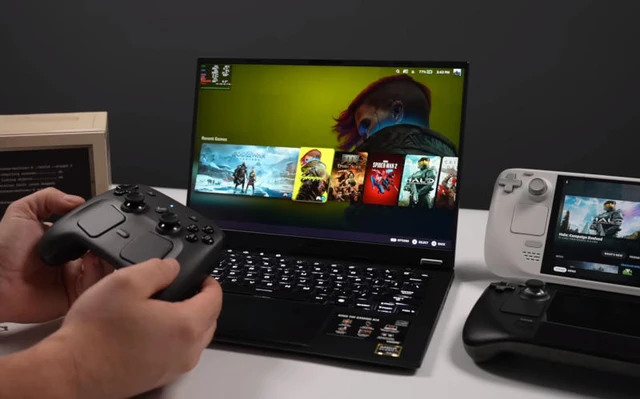
The pursuit of a universal gaming device—one that fuses the flexibility of an open OS with the seamlessness of a console interface—has led to a series of ambitious experiments utilizing the SteamOS 3.9 recovery image. The chosen testbed for this endeavor was the Asus TUF Gaming A14, powered by one of the industry's most promising modern solutions: the AMD Ryzen AI Max+ 392 hybrid chip. Built on the Zen 5 architecture with 12 cores, this processor features the integrated Radeon 8060S graphics, designed to redefine performance standards for onboard GPUs.
The system's hardware backbone is bolstered by 32 GB of ultra-fast LPDDR5X-8000 memory. This is critical for the iGPU, as the graphics core relies on shared system memory. The visual experience is delivered via a 14-inch display with a resolution of 2560 × 1600 pixels and a 165 Hz refresh rate, while endurance is supported by a 73 Wh battery.
The process of adapting SteamOS to this hardware proved surprisingly fluid. The system demonstrated a high degree of compatibility; both the Game Mode, with its signature interface, and the traditional desktop environment functioned stably. Driver performance deserves particular mention—Wi-Fi, Bluetooth, and USB ports were recognized correctly, which is often a notorious hurdle when installing specialized Linux distributions on consumer-grade hardware.
Moving to practical benchmarks, it becomes evident that the synergy between Strix Halo and SteamOS can handle tasks previously reserved for mid-range discrete GPUs. In modern AAA titles, the system exhibits impressive stability. For instance, in Halo: Campaign Evolved at 1440p on High settings with FSR enabled, the system maintained a steady 70 FPS. Similar results were observed in Crimson Desert.
The most telling test was Spider-Man 2: even with FSR scaling disabled, the system averaged over 80 FPS at 1440p on High settings. However, the iGPU's limits became apparent in Doom: The Dark Ages—on Ultra settings, performance began to dip, and achieving a comfortable 60 FPS required switching FSR to Balanced mode.
Cyberpunk 2077, traditionally regarded as one of the most demanding benchmarks, delivered a stable 60 FPS at 1440p on High settings using FSR 2.1. It is important to note that frame generation was intentionally disabled to evaluate the native raw power of the Radeon 8060S graphics core.
Energy efficiency remains the pivotal question for any portable device. Tests revealed a direct correlation between screen resolution and battery life. At 800p, the laptop operated for approximately 2 hours and 25 minutes, whereas increasing the resolution to 1200p reduced this figure to 1 hour and 40 minutes. Conversely, indie titles like Hollow Knight: Silksong present a completely different picture: at 1200p, the system maintained a stable 60 FPS while power consumption remained below 16W. In such scenarios, the estimated runtime could extend from four to seven hours, positioning the laptop as a viable console alternative for less demanding games.
Ultimately, the experience of integrating SteamOS onto the Strix Halo platform confirms the thesis that modern integrated graphics have reached a threshold allowing for comfortable AAA gaming without the need for bulky discrete GPUs, all while preserving the aesthetics and convenience of the Valve ecosystem.
 The Price of Acceleration: CXMT’s Rapid Push into Memory