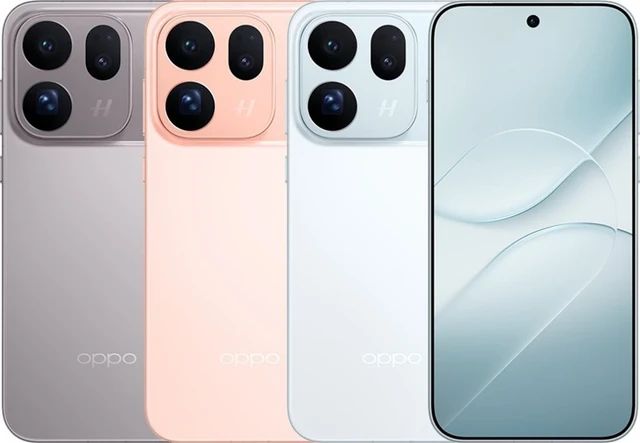
The contemporary smartphone market is entering a phase where incremental hardware iterations are no longer sufficient to trigger a meaningful leap in performance. To justify the "flagship" moniker, manufacturers are now compelled to push the boundaries of energy density and sensor resolution. The Oppo Find X10 series emerges as a direct response to this challenge, delivering an uncompromising fusion of raw computational power and cutting-edge optics. These devices signal a shift toward the "super-flagship" paradigm—a space where hardware extremism converges with intelligent software.
The Oppo Find X10 series is driven by a pursuit of technological dominance, most evident in its choice of hardware. The flagship model is powered by a 3-nanometer MediaTek Dimensity 9600M processor, boasting an impressive clock speed of up to 4.21 GHz. A standout feature is the Tide Engine—a specialized processing layer engineered to mitigate thermal throttling and maintain stable frame rates during resource-intensive workloads. Coupled with 16GB of LPDDR5X RAM and a lightning-fast 512GB UFS 4.1 storage drive, the device evolves into a legitimate mobile workstation.
The visual interface is centered around a 6.59-inch AMOLED display with 1.5K resolution. A 144Hz refresh rate and peak brightness of 2,000 nits ensure fluid motion and exceptional legibility, even under direct sunlight. However, the screen's true value lies in the technical nuances: 3,840 Hz PWM dimming virtually eliminates flicker to reduce eye strain, while Dolby Vision support elevates content consumption to a professional grade. Security and ergonomics are further enhanced by an ultrasonic fingerprint scanner, which offers superior speed and reliability over traditional optical solutions.
The Find X10's optical array is the result of a deep partnership with Hasselblad, aimed at achieving natural color reproduction and high-fidelity detail. The primary 200MP sensor, featuring a 1/1.4-inch physical size and Optical Image Stabilization (OIS), provides exceptional light-gathering capabilities. This is complemented by a periscope telephoto module, also sporting a 200MP resolution, enabling high-quality magnification without sacrificing clarity. A 50MP ultra-wide lens handles expansive shots, while a 50MP front-facing camera caters to selfies and video conferencing.
Energy autonomy is achieved through the implementation of silicon-carbon batteries—a technology that significantly increases capacity without a critical increase in the device's footprint. The 8,000 mAh cell is supported by the SuperVOOC system, featuring 80W wired charging and a 50W wireless standard. IP66, IP68, and IP69 ratings guarantee the device's survival in the most aggressive environments, including exposure to high-pressure water jets.
For those seeking a more balanced solution, the Find X10 E is available. It retains the overall aesthetic and screen dimensions (6.59 inches, 1.5K) but offers a more modest 120Hz refresh rate and 1,800 nits of brightness. Under the hood, it runs an optimized MediaTek Dimensity 9500s clocked at 3.73 GHz, which, paired with the same memory configuration (16/512 GB), delivers high performance with lower power consumption.
The camera system on the "E" version is more conservative, utilizing a trio of 50MP modules (main, telephoto, and ultra-wide)—a configuration that has become the gold standard for the modern premium segment. A 7,025 mAh battery also supports SuperVOOC fast charging, ensuring reliable endurance.
Both devices run ColorOS 17 based on Android 17, where the primary focus is the integration of AI tools to optimize workflows and media processing. From a positioning standpoint, the price gap between the models is marginal: the base Find X10 E is priced at $746, while the full-fledged Find X10 starts at $821. This makes the flagship model an extremely compelling proposition for users demanding peak technical capabilities.
 Apple’s Personal Smart Home Hub