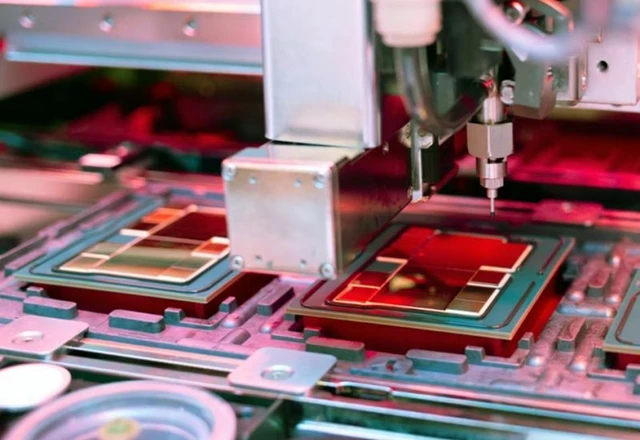
The modern digital economy effectively hinges upon the capabilities of a single Dutch titan. ASML serves as the ultimate gatekeeper in the race for semiconductor performance, wielding absolute control over access to mission-critical lithography technologies. The company’s latest financial results reveal a surging global demand for chip-manufacturing equipment—a trend that underscores a systemic pivot toward new computing paradigms and the massive scaling of artificial intelligence infrastructure.
In the microelectronics industry, there is a concept known as the "bottleneck," and ASML stands as its primary gatekeeper. Since virtually every modern chipmaker—from TSMC to Intel and Samsung—depends on this conglomerate's equipment, the company's quarterly reports serve as a precise bellwether for the health of the global semiconductor market. Recent second-quarter data and updated annual forecasts point toward a phase of rapid acceleration.
Financial metrics demonstrate a confident upward trajectory. For the first time this year, the company has significantly revised its revenue guidance: while the target range was previously set at €36–40 billion, the bar has now been raised to €43–45 billion. Simultaneously, profit margin forecasts have climbed, projected to land between 54% and 56%. The market reacted instantaneously—shares surged, with year-to-date growth reaching an impressive 115%.
Actual second-quarter results also beat market expectations. Revenue reached €9.3 billion against a projected €8.8 billion, while net profit hit €2.9 billion compared to the expected €2.6 billion. This dynamic growth in orders is driven by a global push among tech giants to expand capacity for producing cutting-edge processors and AI accelerators.
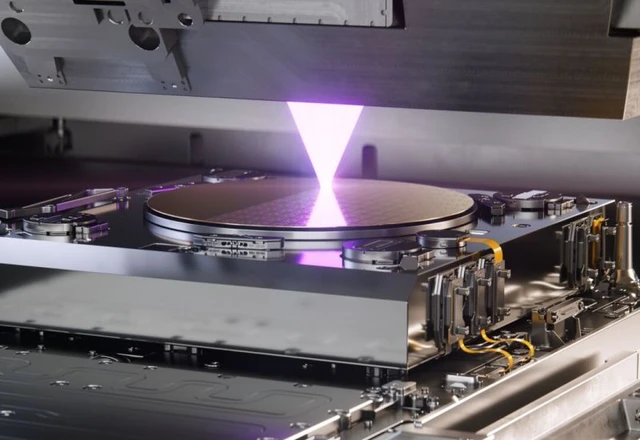
Particular focus is placed on two key segments: Extreme Ultraviolet (EUV) systems and the more accessible Deep Ultraviolet (DUV) scanners. Over the coming year, production volumes for both categories are slated to increase by 30%. Furthermore, ASML has already secured its order backlog through 2028, signaling long-term strategic planning by clients and an urgency to accelerate procurement schedules. This year, the company intends to ship 65 advanced EUV systems, exceeding initial projections.
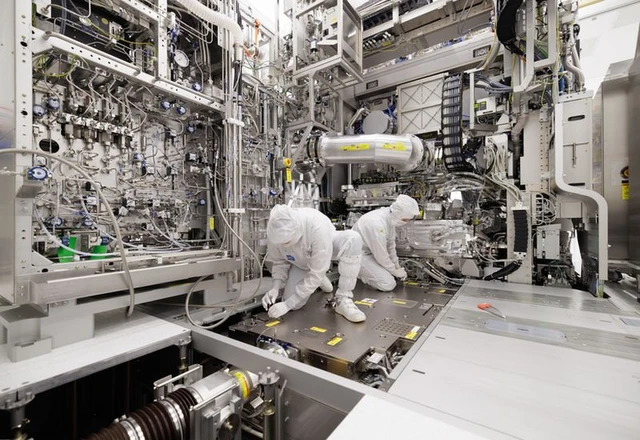
Scaling production of such extreme complexity does not always necessitate a proportional expansion of physical plant footprints. To optimize processes, ASML employs a "forward shipping" strategy. The essence of this method involves shipping partially assembled equipment directly to the customer's site, where final assembly and commissioning are performed on-site. This reduces cycle times and allows for more efficient utilization of existing manufacturing capacity.
The geopolitical landscape also leaves its mark on the business structure. China's share of ASML's total revenue shows a downward trend: starting at 19% at the beginning of the year, it dipped to 14% by the end of the first quarter. It is expected that this share will not exceed 20% by year-end. From a technical standpoint, the gap between the equipment legally supplied to China and the latest High-NA EUV systems now spans eight generations. This creates a formidable technological barrier that cannot be overcome simply by increasing the volume of legacy model acquisitions.
 The Horizon of China's Technological Sovereignty in Lithography