The contemporary entry-level GPU market is increasingly plagued by "stealth segmentation"—a practice where a single model designation masks divergent technical specifications. The Radeon RX 9050 serves as a textbook example of how detrimental reductions in VRAM capacity and memory bus width can be to overall performance. Benchmarks reveal that the stripped-down OEM variant forfeits a substantial portion of its theoretical potential, forcing consumers to question the true cost of these "savings" when selecting a budget graphics solution.
There is a concerning trend in the GPU industry: the release of products with identical nomenclature but fundamentally different specifications. The Radeon RX 9050 serves as a prime example. While the retail market offers a full-fledged 8GB version, an obscure OEM variant with only 4GB exists, supplied exclusively in pre-built systems, such as those from CyberPowerPC. For the average consumer, this distinction may seem negligible, but in practice, it transforms the device into an entirely different product.
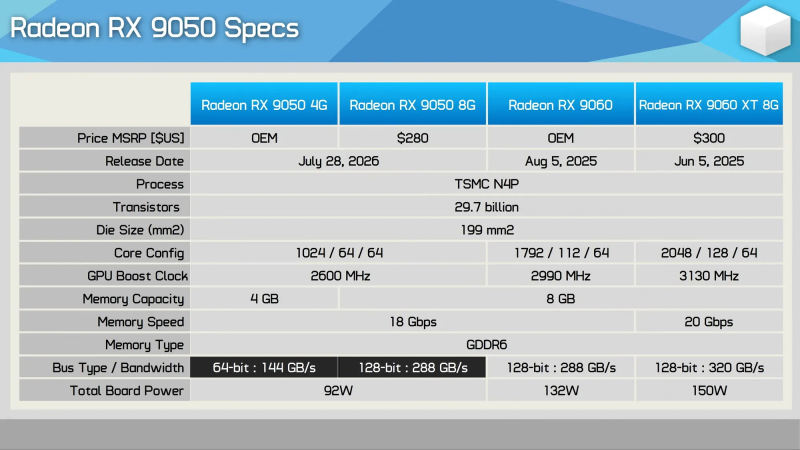
At first glance, one might assume that reducing memory is simply a matter of capacity. However, technical analysis reveals a deeper issue. Both versions of the RX 9050 utilize the same GPU die, featuring 1,024 stream processors and a Boost clock of up to 2.6 GHz. The divergence lies within the memory subsystem. The 4GB version employs a 64-bit bus with GDDR6 chips (18 Gbps), capping bandwidth at 144 GB/s. In the 8GB retail model, these figures are exactly doubled: a 128-bit bus delivers a bandwidth of 288 GB/s.
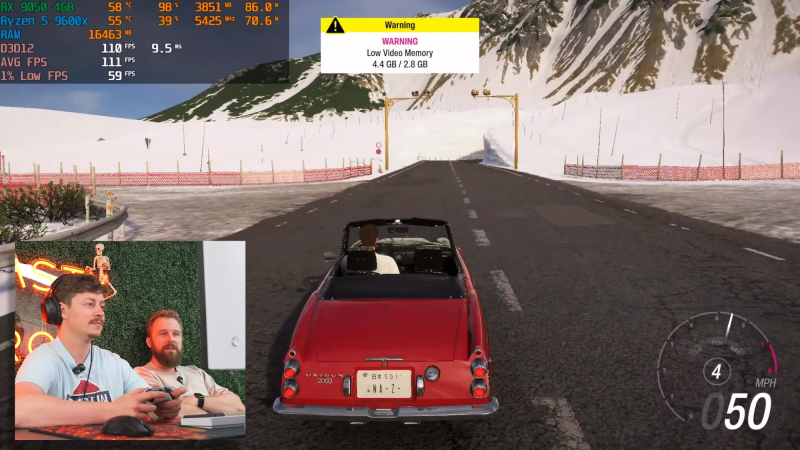
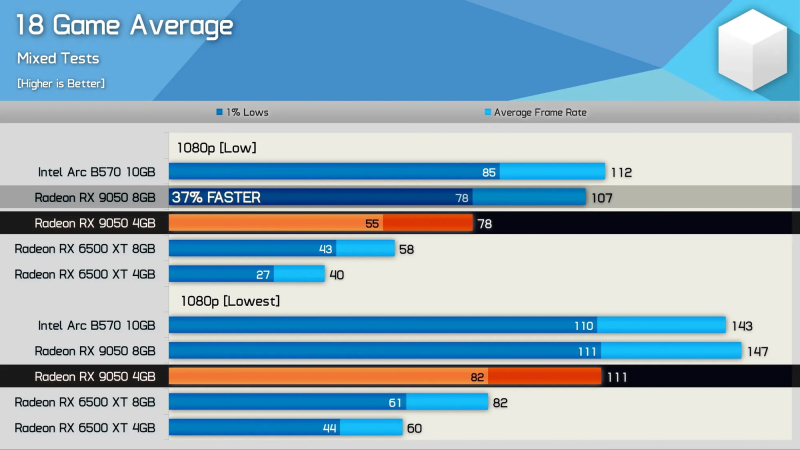
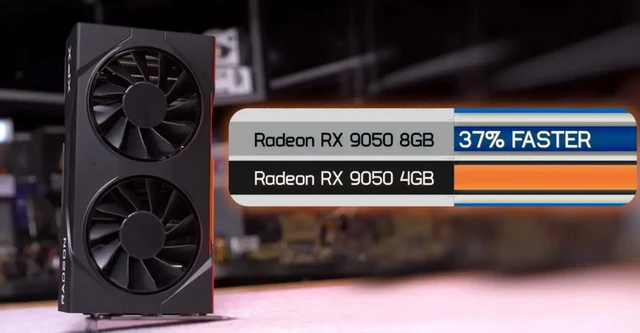
This radical disparity in memory bandwidth leads to a precipitous decline in performance. Benchmarks across 18 modern titles at 1080p with low graphical settings reveal that the 4GB version averages 78 frames per second (FPS), whereas the full-spec model reaches 107 FPS—a performance gap of approximately 37%. Even more alarming is the 1% Low metric (minimum FPS), which plummets to 55 FPS for the crippled version compared to 78 FPS for the superior model, directly impacting gameplay fluidity and causing noticeable micro-stuttering.
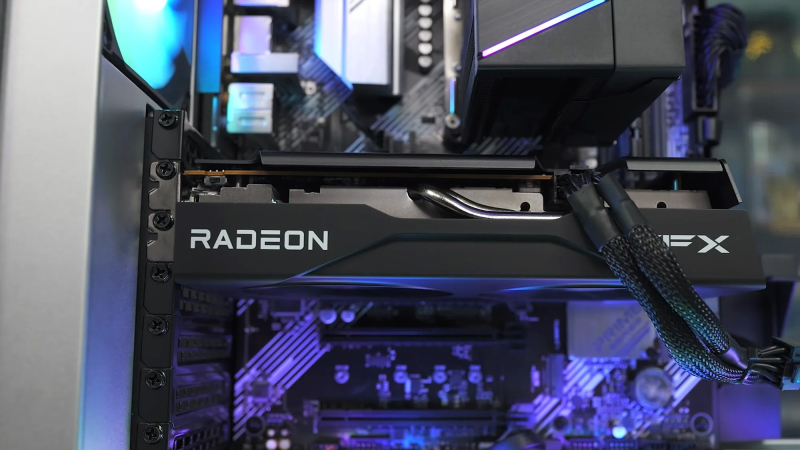
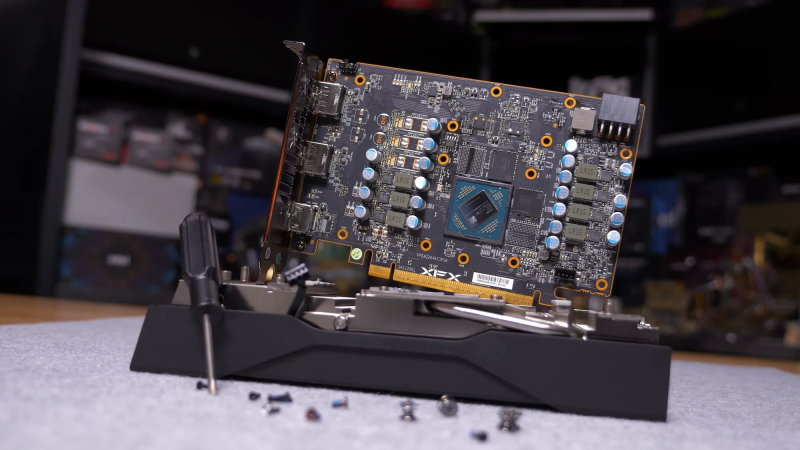
Even under minimal graphical settings, where VRAM demands are lower, the performance gap persists at 32%. For context, a competing solution from Intel—the Arc B570—outperforms the Radeon RX 9050 4GB by roughly 44% under identical conditions, rendering AMD's stripped-down version highly uncompetitive in its segment. Furthermore, the OEM landscape is fragmented; beyond ASRock, XFX also produces 4GB variants, offering their own proprietary cooling solutions and interface configurations.
An additional complicating factor is the overall configuration of the systems in which these GPUs are shipped. OEM builds frequently cut corners not only on the GPU but across the entire hardware stack. For instance, pairing a Ryzen 5 5500 with single-channel 8GB DDR4 RAM creates additional bottlenecks that further stifle the GPU's potential. While migrating to a modern platform featuring a Ryzen 5 9600X and 32GB of DDR5 noticeably improves metrics, it cannot compensate for the inherent hardware-level bandwidth deficiency of the graphics card itself.
Consequently, the Radeon RX 9050 serves as a cautionary tale of how marketing nomenclature can mask technical regression. It is critical for consumers to verify not just the model name, but the specific bus width and memory capacity. In this instance, the divide between a 64-bit and 128-bit memory architecture determines whether the gaming experience is seamless or a constant struggle against frame rate drops.
 Breaking the Lithography Barrier in China