The entry-level GPU market has traditionally been a landscape of stark compromises, where cost and performance exist in constant tension. AMD is now poised to revitalize this segment by integrating the capabilities of its latest microarchitecture into accessible solutions for the mass market. An inadvertent leak of specifications from partner ASRock has offered a first glimpse into the upcoming Radeon RX 9050—a release destined to define the trajectory of budget gaming in the RDNA 4 era.
The industry has grown accustomed to cautious, choreographed reveals; however, the technical specifications of the Radeon RX 9050 have surfaced prematurely due to a publication error on ASRock’s official portal. Although the product pages were swiftly removed, they left behind a detailed digital trail that allows for a clear analysis of the new card's positioning within AMD's lineup.
The architectural foundation of the Radeon RX 9050 reveals a calculated reduction in resources to optimize for energy efficiency and price point. The GPU features 16 Compute Units (CUs) and 1,024 stream processors—effectively halving the resources found in the more potent RX 9060 XT. This tactical scaling directly impacts performance: with a base clock of 1920 MHz and a boost up to 2600 MHz, its theoretical FP32 throughput sits at approximately 5.3 TFLOPS. By comparison, the RX 9060 XT delivers 12.8 TFLOPS, highlighting a substantial performance gap between these two tiers.
Despite its budget positioning, the Radeon RX 9050 fully inherits the RDNA 4 technology stack. This includes the integration of third-generation ray-tracing accelerators and updated second-generation AI blocks. Such an approach allows AMD to bring modern rendering techniques and upscaling capabilities—once the exclusive domain of flagship hardware—to entry-level users.
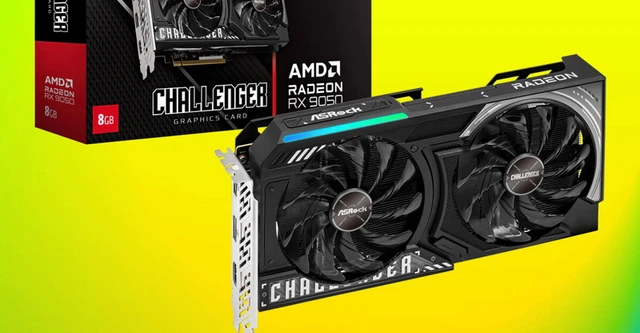
The memory strategy is particularly noteworthy. ASRock is preparing a Challenger variant equipped with 8 GB of GDDR6 VRAM. With a speed of 18 Gbps per pin and a 128-bit bus, the bandwidth reaches 288 GB/s—a respectable figure for an entry-level card. However, a more modest 4 GB version exists, intended exclusively for the OEM segment and pre-integrated systems. In this iteration, the bus narrows to 64-bit, throttling bandwidth to 144 GB/s, which will likely create bottlenecks when handling high-resolution textures in modern titles.
In terms of physical implementation, the Challenger model is a classic dual-fan design, measuring 249 × 132 × 41 mm and weighing 645 grams. Power requirements remain modest: it utilizes a single standard 8-pin PCIe connector, with a recommended PSU wattage of 450W. The I/O suite adheres to current standards, offering two DisplayPort 2.1a ports and one HDMI 2.1b port.
Early sightings of the hardware have already appeared in CyberPowerPC prebuilt systems priced around $890. While AMD has yet to officially confirm the specifications or release date for the Radeon RX 9050, the aggregated data points toward a clear strategy: creating an accessible entry point into the RDNA 4 ecosystem without compromising on the fundamental suite of modern graphical technologies.
 AMD’s Strategic Approach to the Budget Segment