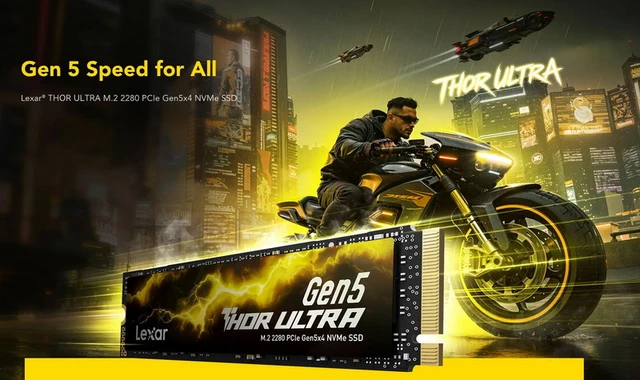
The industry's migration to the PCIe 5.0 standard heralds a new era of data transmission, where bandwidth has become the critical differentiator for high-end professional workstations and gaming rigs. Today's most demanding workloads—ranging from 8K video production to the deployment of massive neural networks—demand more than just raw capacity; they require near-instantaneous latency and extreme responsiveness. Lexar is entering this arena with the Thor Ultra series, delivering a solution designed to blur the line between traditional storage and system memory. This release represents the current technological zenith of consumer-grade NVMe storage.
The debut of the Thor Ultra series marks a pivotal evolution in the landscape of solid-state storage. The lineup spans a broad spectrum of capacities—from entry-level 512 GB models to a formidable 4 TB flagship—each tailored for distinct use cases. However, the series' true potential is realized in the 1 TB, 2 TB, and 4 TB variants, where sequential read speeds hit a staggering 11 GB/s and write speeds climb to 10 GB/s. These benchmarks effectively eliminate bottlenecks when moving massive datasets, transforming the loading of resource-heavy applications into an instantaneous process.
The performance disparity between the entry-level and high-end models is particularly telling. While the 512 GB version remains exceptionally fast with read speeds up to 9,900 MB/s, it sees a noticeable dip in write performance, dropping to 5,000 MB/s. This is a classic characteristic of SSD architecture: a lower number of parallel memory channels inherently limits overall throughput.
Crucial to the user experience are the random read/write metrics (IOPS), which dictate system responsiveness under real-world workloads. In the 2 TB and 4 TB models, these figures reach 2.2/1.9 million and 2.0/1.9 million IOPS, respectively. By comparison, the 512 GB model delivers 900k read operations and 1.2 million write operations. This gap underscores that high-capacity drives are becoming the primary tool for database management and complex software environments, where rapid access to fragmented small files is critical.
Under the hood, the Thor Ultra leverages a cutting-edge 6nm controller process. Notably, Lexar has opted for a DRAM-less architecture, utilizing an SLC cache and Host Memory Buffer (HMB) technology. In traditional terms, the absence of a dedicated DRAM chip might be viewed as a compromise; however, when paired with PCIe 5.0 and optimized power management, it significantly reduces heat output. This is vital, as fifth-generation drives are prone to overheating, which inevitably leads to thermal throttling—the forced reduction of clock speeds to prevent hardware damage.
Endurance and reliability are backed by rigorous metrics. A five-year warranty and a Mean Time Between Failures (MTBF) of 1.5 million hours make these SSDs suitable for intensive professional use. The endurance rating (TBW) scales proportionally with capacity, ranging from 350 TBW for the base model to 3,000 TBW for the 4 TB version. The latter suggests the drive can withstand several petabytes of data writes before the memory cells begin to degrade.
Rounding out the ecosystem is the proprietary DiskMaster software suite. It handles drive health monitoring, firmware updates, and data security, transforming the hardware into a fully manageable tool. While pricing details remain undisclosed, the Thor Ultra is positioned as an uncompromising solution for power users for whom the standards of PCIe 4.0 are no longer sufficient.
 The Price of Acceleration: CXMT’s Rapid Push into Memory