The contemporary GPU landscape is undergoing a strategic shift toward optimization and energy efficiency, where compactness has evolved into a primary driver for the mainstream market. Within this framework, the emergence of new entry-level hardware is prompting a fundamental rethink of budget gaming. PowerColor’s Reaper iteration of the Radeon RX 9050 represents a calculated attempt to forge a balanced instrument for both professional tasks and entertainment—a solution engineered for those who prize stability and minimalist efficiency over redundant resource expenditure.
The heart of this latest graphics solution is the Navi 44 die, which in this iteration operates in a scaled-back configuration. The engineering approach here is purely pragmatic: only 16 of the 32 available Compute Units are active. This results in 1,024 stream processors, supported by 32 AI accelerators and 16 ray-tracing cores. Such a configuration positions the card as an efficient tool for mid-range tasks—ideal for scenarios where extreme computational power isn't required, but modern feature sets are essential.
The memory subsystem is built on the GDDR6 standard, delivering an effective data rate of 18 Gbps per pin. Utilizing a 128-bit bus allows the card to achieve a bandwidth of 288 GB/s, an optimal metric for a GPU in this class. The total VRAM capacity stands at 8 GB—sufficient for most contemporary titles at Full HD resolution with moderate graphical settings.
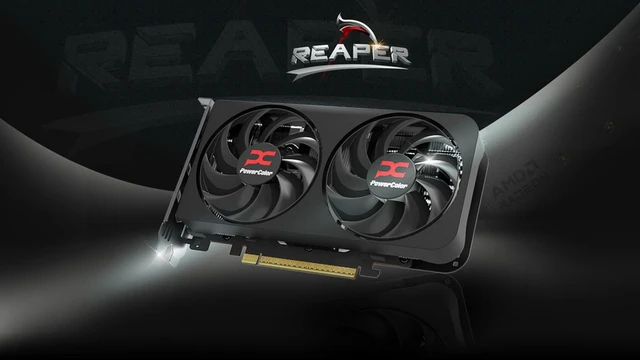
In terms of physical execution, the Reaper series embraces functional minimalism. The cooling system relies on an aluminum heatsink paired with two 80mm fans, ensuring adequate thermal dissipation without excessive noise. The chassis is constructed from plastic, including the protective backplate, underscoring the product's budget-oriented positioning. With dimensions of 200mm in length and 100mm in height, the card can be integrated into virtually any modern chassis, occupying two standard expansion slots.
The power profile of the Radeon RX 9050 is remarkably modest, with an estimated power draw of just 100W. Power delivery is handled via a single 8-pin PCIe connector, significantly lowering the requirements for the power supply unit and reducing the overall thermal load on the system. PowerColor has adhered to reference GPU clocks, setting the base gaming frequency at 1920 MHz, with the ability to automatically boost up to 2600 MHz.
The connectivity suite aligns with current industry standards. The board features two DisplayPort 2.1a ports and one HDMI 2.1b port, guaranteeing compatibility with modern high-refresh-rate monitors and televisions with deep color reproduction. Ultimately, this is a classic "workhorse" for modern gaming: compact, energy-efficient, and eschewing aggressive factory overclocking in favor of rock-solid stability.
 Virtual Gamepads within the Google TV Ecosystem