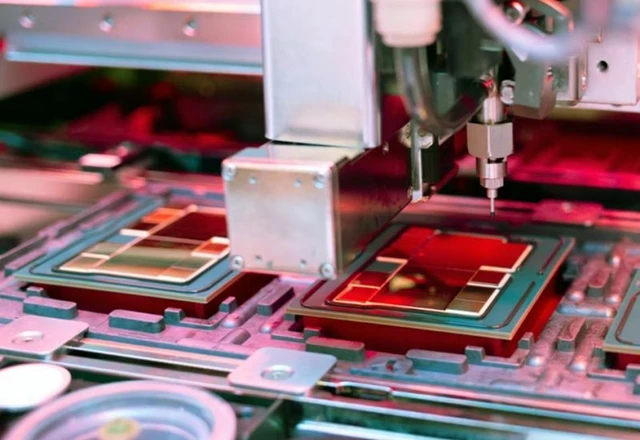
Striking the ideal synergy between hardware and software remains one of the defining challenges of the modern gaming industry. Valve’s compact gaming systems have evolved into a critical proving ground, testing the extent to which an operating system can unlock a machine's raw hardware potential. Recent benchmarks of a modified Steam Machine illuminate the stark contrast between the specialized optimization of SteamOS and the broad versatility of Windows. The findings reveal a significant divergence in synthetic performance, yet they demonstrate nearly identical behavior in real-world gaming scenarios.
The optimization of hardware-software synergy has always been pivotal to the console experience. Recent evaluations of the Steam Machine sought to determine how effectively native SteamOS performs compared to Windows. To ensure experimental integrity, a modified unit was utilized: the DDR-5600 RAM was expanded from the base 16GB to 64GB. While this upgrade deviates from factory specifications, it allowed for an assessment of the system's absolute ceiling when utilizing official Valve drivers for Windows.
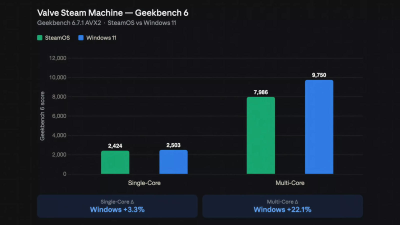
The most pronounced disparities emerged during Geekbench 6 synthetic benchmarks. Here, Windows demonstrated a clear advantage: while single-core performance saw a modest 3.3% uplift, the gap in multi-threaded computations became truly substantial, reaching 22%. Such a significant leap suggests more efficient CPU resource allocation or specific nuances within the Windows task scheduler that better leverage multi-core architectures under heavy loads.
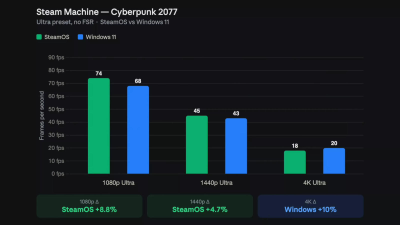
However, real-world gaming performance proved far less dramatic. In Cyberpunk 2077—one of today's most demanding titles—results fluctuated based on the chosen resolution. At standard 1080p, SteamOS outperformed Windows 11, delivering 74 FPS compared to 68. The tide turned at 4K: here, Windows managed to eke out 20 FPS, while SteamOS plateaued at 18.
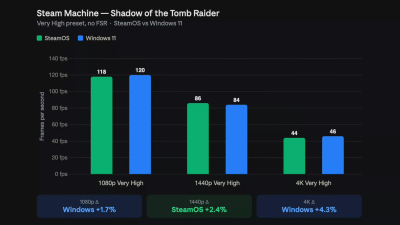
In other titles, the performance gap virtually vanished. In Shadow of the Tomb Raider, frame rates across 1080p, 1440p, and 4K differed by only a few frames—well within the margin of statistical error. A similar pattern emerged in Horizon Zero Dawn. Notably, achieving acceptable fluidity in both titles required the use of image upscaling technologies, which have become an industry standard for maintaining high frame rates on compact hardware.
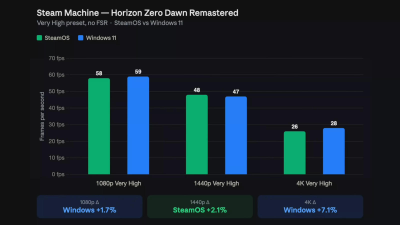
Ultimately, despite the impressive figures seen in benchmarks, the practical performance delta between SteamOS and Windows remains minimal. This reinforces the thesis that current levels of driver optimization and compatibility layers allow for nearly identical results regardless of the platform, shifting the primary focus from raw horsepower to the quality of the user interface and the surrounding ecosystem.
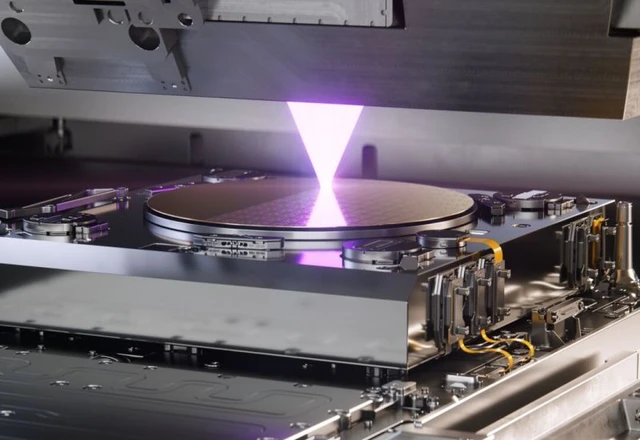 The Horizon of China's Technological Sovereignty in Lithography