The modern high-performance computing (HPC) market is evolving into a strategic battlefield where general-purpose CPUs clash with specialized accelerators. Recent assertions from AMD regarding the superiority of its Zen 6-based Epyc lineup over Nvidia’s Vera solution have sparked significant debate across the industry. Yet, beneath these bold performance metrics lies a complex methodological discrepancy that casts doubt on the objectivity of the comparison. This case serves as a poignant reminder of how thin the line can be between a genuine technological breakthrough and the strategic curation of data for marketing purposes.
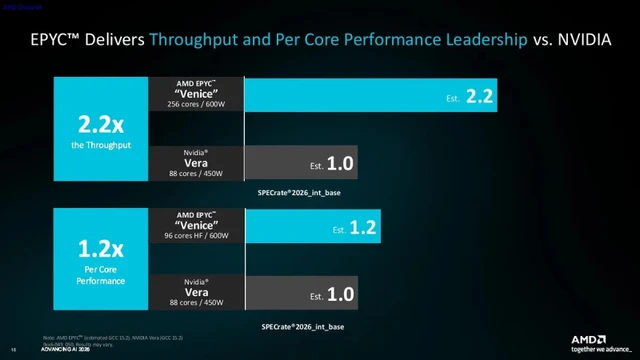
Corporate intelligence and the reciprocal analysis of benchmarks have become intrinsic to the cutthroat competition within the data center segment. When Nvidia published SPEC CPU 2026 integer performance data for its Vera processor, AMD responded promptly. Company leadership expressed an unexpected satisfaction with their competitor's results, claiming that internal tests of the Zen 6-based Epyc Venice yielded even more impressive figures. According to AMD, their solution demonstrates throughput 2.2 times higher than Vera, with per-core efficiency exceeding it by a factor of 1.2.
However, a closer look at the methodology reveals a classic "apples-to-oranges" comparison. AMD pitted a dual-processor configuration of its 256-core Epyc 9996 chips—with a Thermal Design Power (TDP) of 600W—against a single 88-core Nvidia Vera processor with a TDP of 450W. From a technical standpoint, this framing is dubious: a device boasting nearly triple the core count and significantly higher power consumption will naturally exhibit superior aggregate throughput. Nvidia itself emphasizes that Vera is not intended as a direct competitor to Venice; rather, it was engineered for a specific set of workloads where resource allocation priorities differ from those of traditional server CPUs.
The calculation of per-core performance is particularly telling. This was derived using the SPECrate_int metric—a measure of the total work completed by all system threads over a specific duration. To arrive at an "individual" result, the total score is divided by the number of cores. While Vera scored 925 points, AMD claimed a result of 1210 for its 96-core Epyc processor. This is where the first major discrepancy emerges: a chip with those specific characteristics and a 600W TDP does not officially exist. The closest analog, the Epyc 9686F, clocks up to 5 GHz but is capped at a 500W TDP.
By manipulating the processor samples used across different tests, AMD is able to claim an 18.8% advantage (the aforementioned "1.2x" lead). However, applying a fair calculation to the flagship Epyc 9996 radically alters the narrative. In such a scenario, Nvidia Vera's per-core performance proves to be approximately 1.3 times higher than AMD's solution. Furthermore, even when compared to the more efficient Epyc 9686F, the Nvidia chip maintains its edge, effectively neutralizing the claim of Zen 6's absolute leadership in this specific metric.
It is critical to recognize that these figures are preliminary and intended primarily for introductory purposes. SPEC standards impose rigorous reporting requirements; until official certified results are published, any conclusions remain speculative. Compiler optimization plays a pivotal role here—while both companies utilized GCC 15.2, fine-tuning the software for a specific microarchitecture can significantly shift performance benchmarks.
Ultimately, the current dispute centers solely on integer performance. For a comprehensive evaluation of server hardware, floating-point performance and vectorized computations are paramount—areas where AMD has traditionally excelled thanks to its instruction set extensions. Until the floating-point data is released, the final verdict on who will emerge as the true leader of the next generation of server computing remains pending.
 The Triumph of 3nm Chip Manufacturing