The computer hardware industry is frequently plagued by planning paradoxes, where a product's actual release lags years behind the initial announcement of the technology. The AMD B650E chipset, which promised comprehensive PCIe 5.0 support, only made its way into MSI's portfolio after a considerable delay. Amidst the aggressive migration to newer generations of Ryzen processors, the introduction of this motherboard appears to be a strategic move to close a gap in the product lineup. The device strikes a balance between the demand for extreme data throughput and a pragmatic approach to modern system architecture.
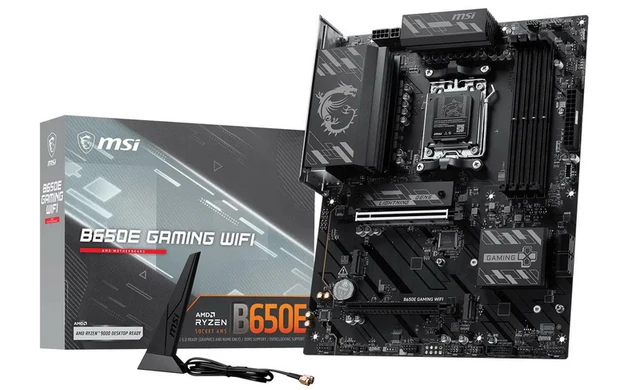
The arrival of the MSI B650E Gaming WIFI feels like a strange technological retrospective. The B650E chipset was introduced to the market back in August 2022 alongside the debut of the Ryzen 7000 processors, with the first wave of based solutions hitting shelves almost immediately. Yet, despite already offering more modern B850-based models in its lineup, MSI has decided to supplement its portfolio with a B650E board only now—nearly four years after the standard was first mentioned.
The defining characteristic of the "E" (Extreme) variant, as opposed to the standard B650, is the guaranteed support for the PCIe 5.0 interface. While base chipsets leave the implementation of this standard to the manufacturer's discretion, the B650E mandates PCIe 5.0 support for both graphics cards and NVMe drives. This ensures the board remains relevant for users planning to deploy future ultra-high-speed SSDs or GPU accelerators that demand maximum bandwidth.
The technical foundation of the MSI B650E Gaming WIFI is designed for a broad spectrum of processors, ranging from the Ryzen 7000 and 8000 series to the current 9000 series. The primary PCIe x16 slot operates fully in 5.0 mode when paired with flagship CPUs, although bandwidth may be reduced when using 8000-series hybrid processors (APUs), depending on the specifications of the specific die.
Storage architecture is centered around three M.2 slots. The primary slot operates in PCIe 5.0 x4 mode, delivering uncompromising read and write speeds, while the remaining two slots function in PCIe 4.0 mode (x4 and x2, respectively). For legacy storage, four SATA III ports are provided.
The board's power delivery is impressive: system stability is managed by a 15-phase VRM (12+2+1 configuration), allowing it to handle even the most power-hungry multi-threaded processors with ease. Power is supplied via standard 8- and 4-pin EPS connectors, and the board utilizes a six-layer PCB—a critical factor in minimizing signal interference when working with high-frequency memory.
Memory is handled by four DIMM slots supporting up to 256 GB of DDR5. MSI claims overclocking capabilities of 8000 MHz and beyond when using compatible Ryzen 9000 processors. Of particular note is the support for AMD EXPO profiles and CUDIMM modules with integrated clock generators, which elevates the stability of timing and frequency management to a new level.
When comparing this newcomer to its predecessor—the MSI B650 Gaming Plus WIFI—a calculated compromise becomes evident. The new model wins out by introducing PCIe 5.0 for the GPU and SSD, and by increasing the M.2 slot count from two to three. However, this technological leap comes at the cost of external interface speeds: while the older model featured a 20 Gbps USB-C port, the B650E Gaming WIFI is limited to 10 Gbps.
For now, MSI is maintaining an air of mystery regarding pricing and exact retail availability, positioning the board as a quiet but strategic addition to its catalog.
 Scaling Next-Generation Chip Production