Contemporary data transmission networks are rapidly approaching the physical capacity limits of traditional silica-core fiber. Amidst an exponential surge in traffic and increasingly stringent demands for ultra-low latency, the search for alternative signal propagation media has become a critical imperative for global infrastructure. Cutting-edge experiments with hollow-core fibers (HCF) are paving the way for a fundamental paradigm shift in the architecture of backbone channels. Recently, Chinese engineers demonstrated a technology capable of significantly expanding network capacity while minimizing transmission losses over long distances.
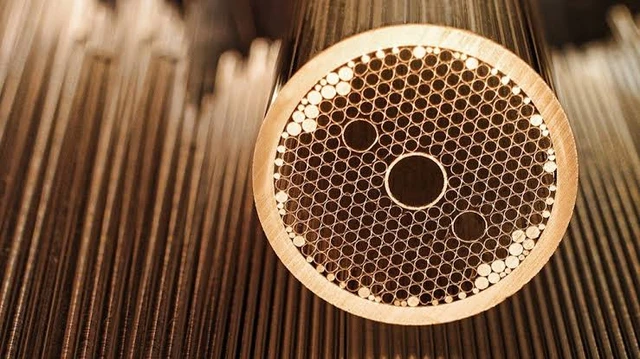
The fundamental distinction between traditional optical fibers and their hollow-core variants resides in the transmission medium. In standard cabling, light interacts with a dense silica core, inevitably triggering signal loss, non-linear effects, and increased latency—a byproduct of silica's higher refractive index relative to air. Hollow-core fiber bypasses these limitations by routing the signal through an air channel, pushing propagation speeds closer to the theoretical maximum achieved in a vacuum.
Recent test results are striking: the system achieved an aggregate throughput of 51.3 Tbps. Of particular significance is the transmission distance—approximately 206 kilometers traversed without the need for intermediate amplifiers. In conventional systems, the absence of signal regeneration over such a span would result in critical data degradation; however, the unique properties of the hollow-core architecture minimize attenuation and preserve stream integrity.
The technological breakthrough extends beyond the physical medium to the intelligent orchestration of data transmission. Rather than relying on static parameters, engineers have implemented an adaptive rate-tuning mechanism for individual wavelengths. This is augmented by a dynamic power redistribution system between channels, enabling the network to self-optimize in real-time based on environmental fluctuations or load demands.
Beyond raw throughput, significant emphasis was placed on system resilience. The integration of rapid fault-signaling mechanisms and emergency shutdown protocols transforms this experimental testbed into a viable industrial prototype.
This approach to data transmission is strategically pivotal for the evolution of next-generation infrastructure. Reduced latency will be the decisive factor for high-frequency trading (HFT), real-time cloud computing, and autonomous vehicle control systems—environments where every millisecond of delay can be critical. This project, a collaborative effort between telecommunications operators and optics manufacturers, effectively validates the viability of "air-core" backbones for national-scale communication networks.
 Next-Generation Ultra-Lightweight Lens Technology