By mid-2026, the conventional hardware upgrade cycle had descended into a profound systemic crisis. A surge in memory pricing, coupled with a stagnation in the rollout of new platforms, forced users to pivot from full system overhauls toward incremental, targeted upgrades. In this climate, motherboard manufacturers found themselves uniquely vulnerable, stripped of their primary catalyst for sales growth. Gigabyte’s response to this shift was a strategic reimagining of its product positioning: the introduction of a specialized series tailored specifically for the high-demand Ryzen X3D processors.
For years, the personal computer market operated on a predictable cycle: the release of a new CPU generation inevitably triggered a mandatory upgrade of both the chipset and system memory. However, the economic landscape of 2026 shattered this paradigm. The cost of transitioning to modern DDR5 standards became prohibitive, shifting consumer demand toward highly efficient, localized incremental upgrades. Consequently, the industry fractured; while memory manufacturers offset falling sales volumes with price hikes, motherboard vendors faced a catastrophic slump in demand.
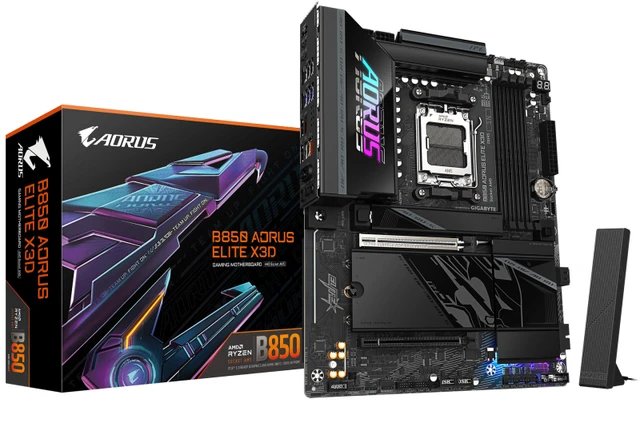
Against this backdrop, Gigabyte’s strategy appears as a calculated blend of strategic marketing and precision engineering. Rather than offering another generic, all-purpose board, the company developed the X3D family—specifically tailored for processors with expanded cache, which have effectively become synonymous with "gaming CPUs" for the mass market. The B850 Aorus Elite X3D serves as the entry point into this ecosystem, striking a deliberate balance between cost and capability.
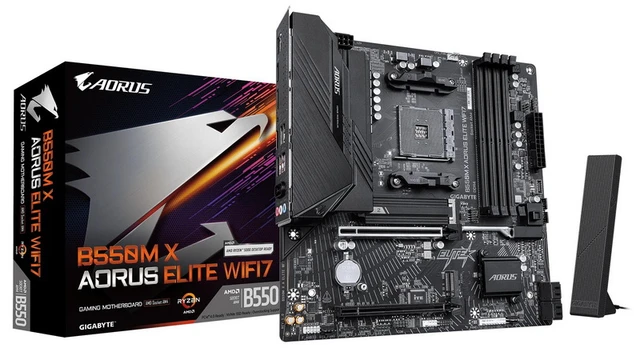
From a technical standpoint, the B850 Aorus Elite X3D is not a revolutionary product built from the ground up. Instead, it is a refined iteration of the previous Aorus Elite WiFi7, with the primary enhancements focused on the board's "foundation." Engineers have significantly overhauled the Voltage Regulator Module (VRM), implementing an 8-phase design based on the Richtek RT3678BE controller and Onsemi NCP302155 power stages. This configuration allows the board to handle even the flagship Ryzen 9 9950X3D with confidence, which can peak at 270W. Thermal efficiency is maintained via massive aluminum heatsinks linked by a heat pipe, preventing PCB overheating even under extreme multi-threaded workloads.
The handling of PCI Express lanes deserves particular attention. In most Socket AM5 solutions, installing two PCIe 5.0 drives inevitably led to the degradation of the primary graphics slot to x8 mode. Gigabyte has successfully resolved this bottleneck: utilizing two ultra-fast SSDs no longer restricts GPU bandwidth, which retains a full PCIe 5.0 x16 connection. This is a critical nuance for high-end systems where any latency in data exchange between the GPU and CPU is unacceptable.
The board's layout reflects a mature approach to ergonomics. While the use of a six-layer PCB imposes certain limits on extreme memory overclocking (stability is guaranteed up to DDR5-8200), this is more than sufficient for real-world gaming scenarios. The integration of EZ-Latch Plus mechanisms significantly streamlines the build process: the graphics card can be released with a single button press, and M.2 drives are secured without the need for screws.
Networking capabilities have also seen an upgrade. The transition to the Realtek RTL8126 controller provides support for speeds up to 5 Gbps, becoming increasingly relevant as high-speed home networks proliferate. Although the Realtek Wi-Fi 7 module does not unlock the full potential of the standard due to channel width limitations in the 6 GHz band, overall system connectivity remains high. A key strategic decision was increasing the BIOS chip capacity, effectively guaranteeing support for future Zen 6 and Zen 7 processor generations without loss of functionality.
The centerpiece of the marketing campaign is X3D Turbo Mode 2.0. To the end-user, this appears as an "intelligent" toggle in the BIOS offering Standard, Max Performance, and Extreme Gaming profiles. In reality, behind this AI facade lies a meticulously tuned set of PBO (Precision Boost Overdrive) and Curve Optimizer parameters.
The Standard profile essentially lifts power limits and modestly increases clock speeds via Boost Override while simultaneously lowering voltage to optimize thermals. Max Performance attempts to manipulate the base generator frequency, while Extreme Gaming disables SMT (Simultaneous Multithreading) and optimizes tREFI memory timings to minimize latency.
Practical benchmarks reveal that X3D Turbo Mode 2.0 is not a "magic bullet." The performance gain in games is a modest 1–2%, which is expected for X3D processors whose stock frequencies are already near their ceiling. Furthermore, an experienced enthusiast can achieve similar or even superior results through manual undervolting via the Curve Optimizer. However, the value of this feature lies in its accessibility: the average user gains a stable, verified overclock with a single click, without having to dive into the complexities of the UEFI.
Ultimately, the Gigabyte B850 Aorus Elite X3D is a paradoxical product. Its primary value lies not in the loudly touted "turbo mode," but in the flawless engineering of its core functions. It is a mature platform, devoid of "growing pains," featuring excellent power delivery and thoughtful PCIe lane routing. The X3D branding served as a convenient catalyst for launching an updated lineup that rightfully stands as one of the best in its class for modern AMD-based systems.
 The Price of Acceleration: CXMT’s Rapid Push into Memory