The PC industry's migration to Arm architecture is emerging as one of the defining technological shifts of the decade. Nvidia is addressing this pivot with its RTX Spark platform, aiming to dissolve the boundary between mobile energy efficiency and uncompromising desktop performance. The enlistment of the world's leading game publishers underscores the strategic ambition of building a comprehensive ecosystem for Windows on Arm. The objective has evolved beyond mere compatibility; it is now about achieving deep, native synergy between software and silicon.
The gaming industry is undergoing a massive strategic pivot toward Nvidia's latest ecosystem. Ahead of the autumn launch of the RTX Spark platform, industry heavyweights including Electronic Arts, Embark Studios, and Ubisoft have joined the partner ranks. This expanding roster of developers signals that the market is finally ready to embrace Arm-based solutions—architectures long dismissed as niche or confined strictly to the mobile segment.
Among the confirmed projects slated for optimization on the new platform are high-profile titles such as EA Sports F1 25, Apex Legends, Anno 117: Pax Romana, ARC Raiders, and The Finals. These additions bolster an already formidable pool of partners that includes Krafton, NetEase, Riot Games, Xbox, and SEGA. Through this approach, Nvidia is cultivating the critical mass of content necessary to ensure users experience seamless, native support for their favorite titles on the new silicon.
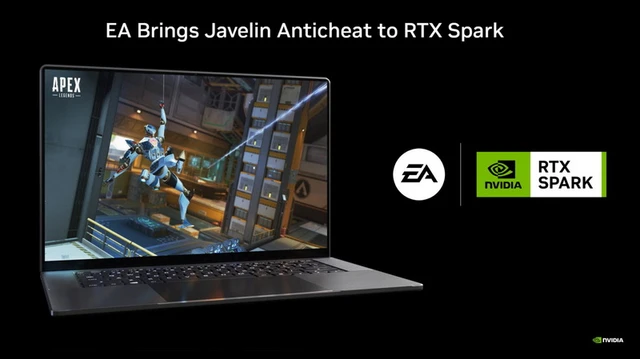
However, the transition to Windows on Arm presents significant technical hurdles that extend far beyond simple code migration. One of the primary pain points is the integration of anti-cheat systems. Traditional 64-bit Windows emulation often proves ineffective against anti-cheat software operating at the kernel level. To resolve this, Nvidia is collaborating closely with Electronic Arts to implement native support for EA Javelin Anticheat directly within RTX Spark. This is a pivotal step for competitive multiplayer disciplines like F1 25, where competitive integrity depends entirely on the synergy between software and hardware.
The technical foundation of RTX Spark is nothing short of a powerhouse. At its core lies the Blackwell RTX GPU, featuring 6,144 CUDA cores, paired with a 20-core Arm-based Grace CPU. Of particular note is the implementation of up to 128 GB of unified memory, which radically slashes data transfer latency between the CPU and GPU. In terms of artificial intelligence, the platform delivers staggering performance—up to 1 PFLOPS in FP4 mode—opening new frontiers for generative content and real-time upscaling.
To ensure a premium user experience, Nvidia has integrated its entire battle-tested technology stack into the platform: DLSS for intelligent scaling, Reflex for minimizing input latency, and G-Sync for flawless frame synchronization. To streamline the transition for developers, the company has already deployed specialized tooling for porting applications to the Arm64 standard, which is expected to accelerate the rollout of native software.
The commercial rollout of RTX Spark will span a wide array of hardware. This autumn, laptops and small-form-factor desktops from leading OEMs—including Asus, Dell, HP, Lenovo, Microsoft, and MSI—are expected to hit the market. While the exact release date remains under wraps, all indicators point toward Nvidia's ambition to establish a new performance benchmark where Arm's energy efficiency meets the raw computational power of Blackwell.
 The Speed Limits of Modern Gaming Displays