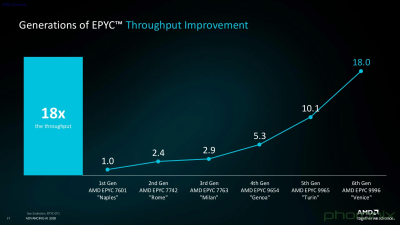
Modern data centers are facing unprecedented strain, driven by the explosive proliferation of neural networks and the processing of colossal datasets. AMD’s response to these demands arrives in the form of its sixth-generation server processors, codenamed Venice. The transition to Zen 6 cores represents a quantum leap in both compute density and memory throughput—a strategic pivot designed to redefine performance benchmarks for high-performance computing (HPC) for years to come.
The server solutions industry is undergoing a profound transformation, where conventional clock-speed increments are no longer sufficient to drive progress. AMD is pivoting toward massive multi-threading and intelligent resource orchestration with the introduction of the EPYC 9006 series. At the heart of this family lie the new Zen 6 cores and their energy-efficient counterparts, Zen 6c, engineered to maximize compute density per square millimeter of silicon.
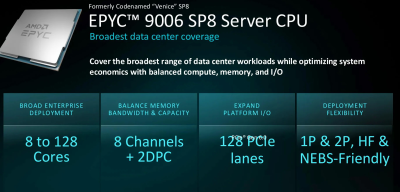
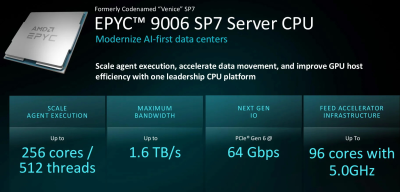
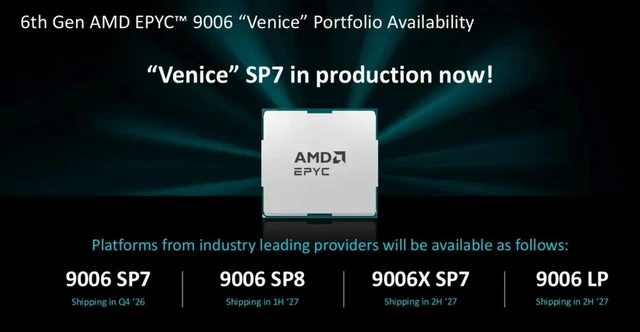
The initial rollout phase will center on the SP7 platform, with systems expected to ship in the fourth quarter of 2026. This platform hosts the most aggressive configurations: flagship models can offer up to 256 Zen 6c cores, delivering a staggering 512 threads for highly parallelized workloads. For scenarios demanding peak single-threaded performance, AMD provides chips featuring 96 Zen 6 cores capable of reaching frequencies up to 5.0 GHz. Subsequently, in the first half of 2027, the market will see the arrival of the SP8 platform, optimized for dual-socket configurations with a core count ranging from 8 to 128.
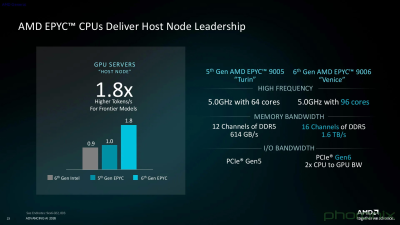
The architectural foundation of the SP7 platform is defined by its massive throughput. Support for 16 memory channels enables data transfer speeds of up to 1.6 TB/s. The integration of DDR5 at 8000 MT/s and second-generation MRDIMM modules (up to 12,800 MT/s) effectively neutralizes the traditional data exchange bottleneck between the processor and memory. Simultaneously, the transition to the PCIe 6.0 interface provides 64 Gbps per lane, while CXL 3.1 support unlocks the potential for composable memory pools and accelerated peripheral interconnects. Such formidable capabilities necessitate robust thermal management; the Thermal Design Power (TDP) for certain models reaches 600W.
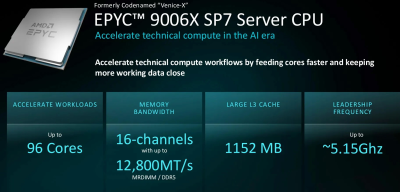
Significant emphasis has been placed on targeted workload optimization. The second half of 2027 will see the launch of the EPYC 9006X (Venice-X) series, where the primary advantage is 3D V-Cache technology. By vertically expanding the L3 cache to 1,152 MB, AMD drastically reduces latency when handling massive databases and complex mathematical models—a critical requirement for High-Performance Computing (HPC) environments. These processors will offer up to 96 cores with clock speeds reaching 5.15 GHz.
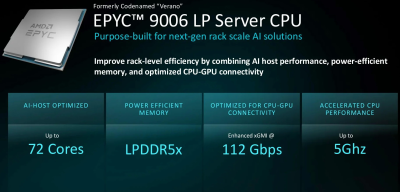
Parallel to this, AMD is developing energy-efficient host solutions tailored for GPU acceleration. The EPYC 9006 LP (Verano) series will utilize LPDDR5X memory via SOCAMM2 replaceable modules. With a maximum of 72 cores and frequencies up to 5.0 GHz, these chips are positioned as the ideal orchestration layer for infrastructures where the primary computational load is shifted to graphics accelerators.
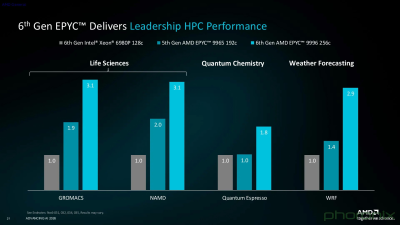
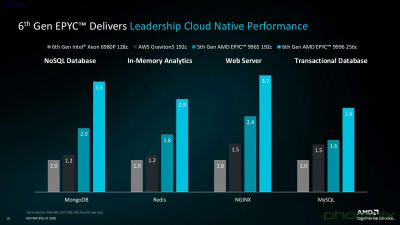
Performance benchmarks reveal a substantial lead over the competition. In a head-to-head comparison between the 256-core EPYC 9996 and the 128-core Intel Xeon 6980P, AMD demonstrates a significant advantage in production-grade workloads. Specifically, performance gains reach 3.7x in NGINX web servers, 3.5x in MongoDB, and over 3x in specialized molecular modeling software such as GROMACS and NAMD.
AMD's strategic expansion extends beyond individual components. These sixth-generation processors will serve as the engine for the new Helios rack systems, which combine the raw power of Venice with cutting-edge hardware layout methodologies. In doing so, the company is building a comprehensive ecosystem where hardware is tightly coupled with the demands of modern cloud and enterprise software stacks.
 The Triumph of 3nm Chip Manufacturing