The boundary between biology and computation is becoming increasingly porous. As traditional silicon chips approach their physical limits, science is seeking alternatives within the fundamental mechanisms of nature itself. Researchers at Meynuta University have unveiled a DNA-based molecular computer capable of executing mathematical operations autonomously. This shift toward thermodynamic computing paves the way for the development of biocompatible systems and ultra-high-density data storage.
The concept of leveraging genetic material for computation is far from novel, yet contemporary approaches are radically shifting the paradigm of how we interact with molecular systems. Previously, the development of DNA computers required immense energy expenditure and constant external oversight, rendering them more theoretical models than practical tools. This new development introduces a level of autonomy akin to quantum annealing: the system is initialized once, after which it autonomously converges toward an optimal result.
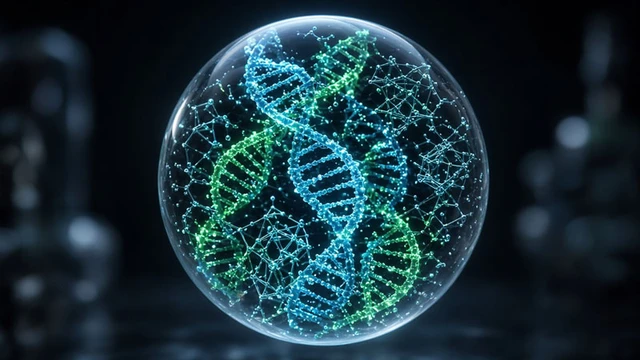
At the heart of this mechanism lies the process of self-assembly. Short DNA strands aggregate around a long molecular backbone, which effectively serves as the "program" or set of instructions for the task. The critical differentiator here is the application of thermodynamics. Following a brief thermal trigger, the molecules begin to rearrange, seeking the most energetically favorable state. The final molecular configuration constitutes the answer to the mathematical problem. Consequently, the computer operates without a continuous power supply or external control, relying instead on the inherent physicochemical properties of the matter.
Empirical tests have validated the method's viability: the system successfully executed ten distinct programs, including fundamental operations such as addition, multiplication, and division. Computational speed varies by task complexity. While simple operations take roughly 30 seconds, processing 100-bit numbers with values reaching tens of millions requires approximately 14 hours. Despite the stark temporal gap compared to electronic processors, the molecular computer demonstrates phenomenal parallelism and minimal energy consumption.
A pivotal technological breakthrough is the ability to reuse the same solution. In previous iterations of such systems, the medium had to be prepared anew for every cycle, creating significant scaling hurdles. The current solution enables dozens of sequential computations without loss of precision or result degradation.
In the long term, DNA computers could occupy niches fundamentally inaccessible to silicon electronics. This includes the creation of ultra-dense data storage and biocompatible devices capable of functioning directly within a living organism. In this architecture, DNA serves simultaneously as the data carrier and the physical processing mechanism. Nevertheless, the road from laboratory prototype to commercial product remains long: researchers still face challenges in increasing reaction speeds, scaling systems, and ensuring absolute reliability in managing complex molecular interactions.
 Forecasting Exponential Growth in Nvidia Shipments