The entry-level GPU market is undergoing a fundamental shift, where efficiency and power consumption are now taking precedence over raw horsepower. The debut of the RDNA 4-powered Radeon RX 9050 marks a new milestone in democratizing cutting-edge graphics technology for users across the Asia-Pacific region and Latin America. Industry leaders Asus and XFX have unveiled their own interpretations of the silicon, offering diverging approaches to thermal management and clock speeds. These implementations demonstrate how even baseline models can achieve substantial performance gains through strategic factory overclocking.
The new Radeon RX 9050 exemplifies AMD's pragmatic approach to the entry-level segment. The card's technical foundation consists of 16 Compute Units and 1,024 stream processors, augmented by 32 AI accelerators and 16 ray-tracing units. With a suggested retail price of $279, the device demonstrates impressive power efficiency: its rated power consumption is just 92W, making it an ideal candidate for small form factor (SFF) builds and systems with limited thermal headroom.
Reference GPU clock speeds are set at 1920 MHz for gaming mode and 2600 MHz in Boost. However, partner solutions push these boundaries further, offering users more aggressive out-of-the-box configurations.
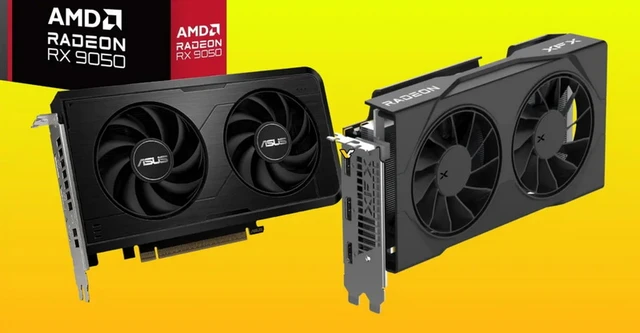
The Asus DUAL-RX9050-O8G stands out with a pronounced factory overclock. In standard mode, its gaming clock rises to 2260 MHz, while the Boost clock reaches 2760 MHz. For enthusiasts, an OC mode is available, pushing the ceiling even higher: up to 2270 MHz and 2770 MHz, respectively. In percentage terms, this represents a 6.5% increase in Boost frequency and a substantial 18.2% jump in gaming clock relative to the reference design.
To maintain stability at these elevated frequencies, Asus has integrated dual Axial-tech fans with zero-dB functionality and included a vented backplate. The device measures 203 × 120.2 × 40 mm. Notably, there is a discrepancy in documentation: while the Japanese office claims a two-slot design, actual retail data indicates a thickness of 2.5 slots.
Conversely, the XFX Swift RX-95SWFT8BE adheres to a philosophy of conservatism and stability. This model utilizes standard GPU settings: a base clock of 1330 MHz, a gaming clock of 1920 MHz, and a Boost clock of 2600 MHz. Despite the lack of an overclock, the card features a more massive chassis (234 × 144 × 51 mm), making it 31 mm longer than the Asus variant. XFX recommends a power supply of at least 450W, although the chip's actual power draw remains at 92W.
The common denominator for both models is the memory configuration: 8 GB of GDDR6 with an effective speed of 18 Gbps per pin and a 128-bit bus. In terms of connectivity, the industry is taking a step forward; both cards are equipped with two DisplayPort 2.1 ports and one HDMI 2.1 port, ensuring compatibility with modern high-resolution displays. Power is delivered via a single traditional 8-pin PCIe connector.
The price gap between the two solutions is marginal: the XFX variant is priced at approximately $332, while the Asus version costs around $344. Ultimately, consumers are presented with a choice between the compactness and aggressive tuning of the Asus model or the traditional reliability and beefier cooling of the XFX offering.
 HDMI 2.2: The New Standard for Data Transmission