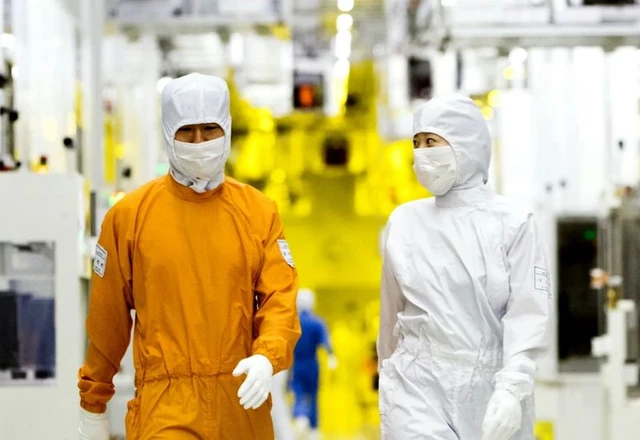
Massive payouts at Samsung Electronics have ignited an unforeseen social upheaval within one of Asia’s most disciplined economies. What began as a precedent of staggering bonuses for memory engineers has evolved into a catalyst for widespread unrest, rippling through the nation’s largest conglomerates. The struggle for financial equity is now inextricably linked to an existential dread regarding automation and the rapid integration of artificial intelligence. South Korea is grappling with a systemic crisis of wealth distribution in the age of high technology.
The spark was ignited within Samsung Electronics' memory chip division, where employees secured exceptional terms: year-end bonuses exceeding $400,000 per person. Within the rigid corporate hierarchies of South Korea, this windfall acted as a detonator. Those left out of this financial triumph—both within Samsung and across other tech giants—saw it as a clear signal to renegotiate their labor conditions.
The chain reaction quickly extended beyond a single enterprise. Demands for higher compensation became the common denominator across multiple industries. In the automotive sector, Hyundai Motor faced partial strikes where financial grievances merged with technological protests. Assembly line workers are demanding not only that up to 30% of the company's consolidated profit be distributed as bonuses but also strict oversight over the robotization of production.
The deployment of advanced automation systems, including Atlas robots, has created particular tension. Labor unions are insisting that any technological innovation be coordinated with employees, effectively attempting to throttle the expansion of machines into traditional workspaces. This shifts the labor dispute from a purely economic conflict into a struggle for the right to dictate the pace of an enterprise's digital transformation.
Parallel to this is a campaign against internal corporate restrictions. At companies such as Hanwha Aerospace and HD Hyundai Electric, employees are demanding the removal of bonus ceilings. For years, Samsung Electronics maintained a strict limit: bonuses could not exceed 50% of an employee's annual income. This barrier is now perceived as an archaic instrument of restraint that must be dismantled.
The digital sector has not remained immune. Thousands of employees at Kakao, the operator of the country's dominant messaging app, have protested for 15% of operating profits to be allocated to staff payouts. Simultaneously, the Naver union has begun forming strategic coalitions with other industry players, seeking to create a united front for negotiations with employers. This signals a transition from fragmented demands toward a systemic unification of the "technological proletariat."
However, for business owners, this dynamic introduces critical risks. For Hyundai Motor, every hour of assembly line downtime results in losses of $13 million, making strikes devastating to corporate financial health. In response to this pressure, South Korean legislators have begun discussing revisions to labor relations norms to limit union capabilities and prevent potential volatility.
The situation has exposed a profound rift between the skyrocketing profits of tech giants and the expectations of the people fueling that growth. Without reaching a new social consensus on the equitable distribution of income, the country's industrial landscape may remain hostage to an endless cycle of protests and mutual accusations.
 The Price of Intellectual Supremacy: Huawei’s Pursuit of Technological Dominance