The line between a standard peripheral and a fully autonomous robot is increasingly blurring. Modern game controllers harbor immense potential, yet this capability is frequently constrained by conventional use cases. A new experimental project illustrates how software-driven approaches can grant a gamepad the ability to navigate physical space autonomously. At the core of this concept lies the synergy between computer vision and haptic feedback.
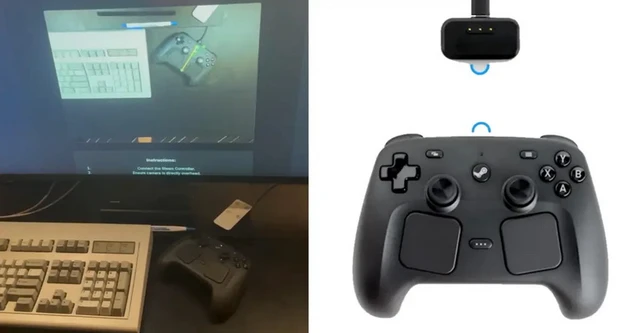
The concept of transforming a static gaming accessory into an autonomous entity is migrating from the realm of science fiction into the domain of applied modding. At the center of this evolution is the Auto-Charge Tracker—a browser-based tool that reimagines Valve's Steam Controller as a miniature robot capable of independently navigating its way back to its charging station.
The mechanics of the process rely on the physical principle of micro-vibrations. Rather than employing wheels or traditional actuators, the system leverages the device's integrated haptic motors. When these motors are activated at specific frequencies and intensities, they generate a series of microscopic impulses that, in aggregate, cause the controller to glide across a smooth desk surface.
To orchestrate this movement, an external camera serves as the system's "eyes." The software tracks specific markers on the controller's chassis to calculate its current coordinates relative to the target. This creates a closed-loop feedback system: the camera captures the device's position, the algorithm computes the necessary movement vector, and a command is sent to activate the corresponding vibration motors to correct the course.
Despite the elegance of the solution, the implementation faces several technical hurdles. The tracking points proved to be highly sensitive to lighting conditions and camera angles, rendering the navigation somewhat "finicky." While the system attempts to memorize the dock's target position, the absence of precision motion sensors means the controller does not always reach its goal on the first attempt. This transforms the charging process into a form of stochastic search, where success depends on surface friction and the precision of the computer vision.
From a hardware perspective, the project complements the existing Valve ecosystem. The controller supports charging via USB-C and a specialized magnetic device known as the "Puck," which functions as both a charging node and a wireless receiver. The Auto-Charge Tracker modification essentially attempts to bridge the final gap in the user experience by automating the device's return to base.
This experiment extends beyond mere novelty. It demonstrates the concept of "hidden functionality" within hardware, where standard components designed for in-game haptic feedback are repurposed for physical interaction with the environment. Such an approach paves the way for entirely new types of interfaces, where devices can provide visual or physical cues by literally moving themselves into the user's field of vision.
 The Phenomenon of the Foldable iPhone Ultra